
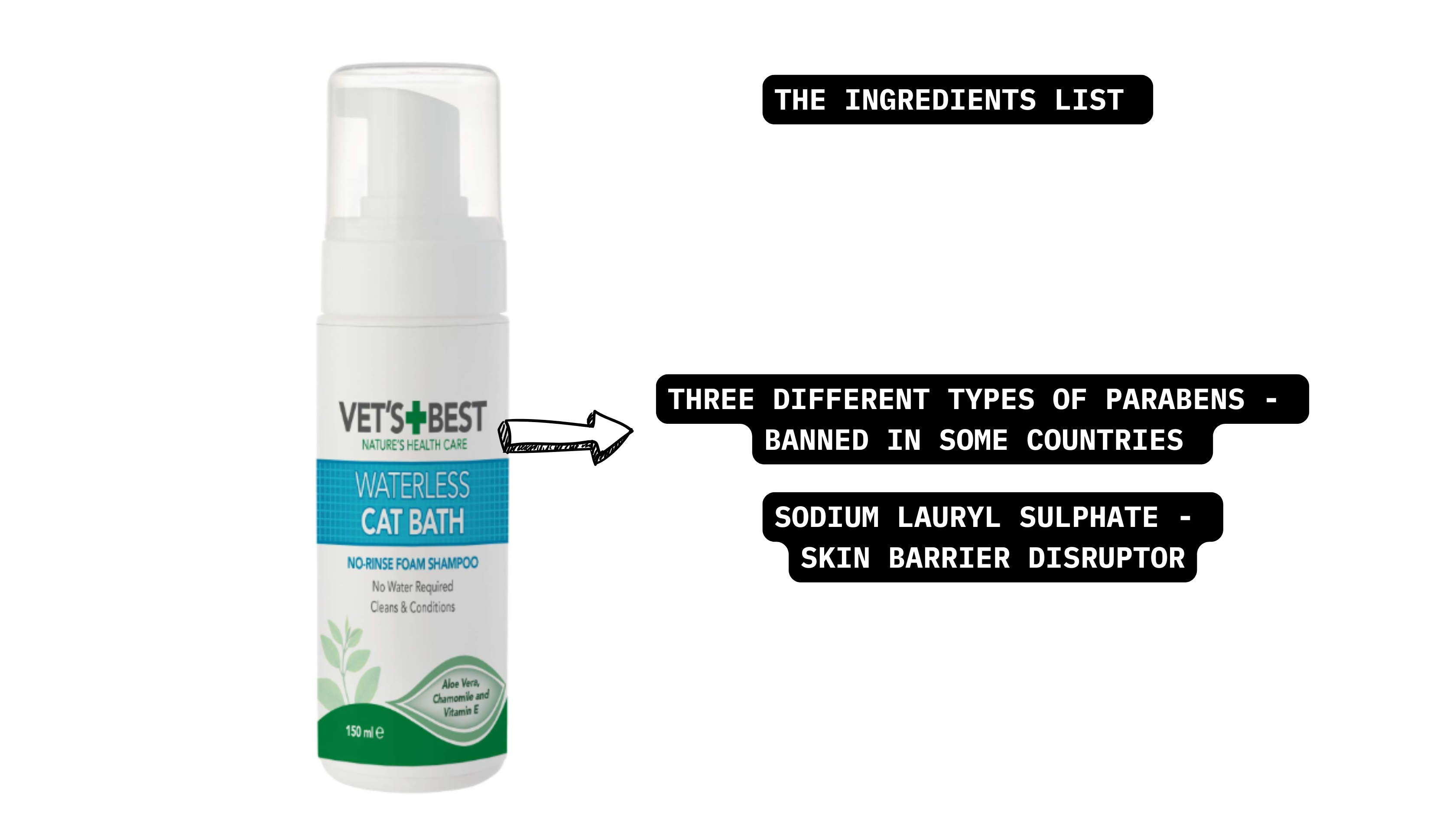
Are parabens safe for dogs and cats? No. Parabens are synthetic preservatives that penetrate pet skin readily, disrupt hormones, and accumulate in body tissue with repeated exposure. This is because a dog's skin is significantly thinner and more permeable than human skin, the risks are proportionally greater for pets than for people.
This guide explains what parabens are, why they appear in so many pet shampoos, the hidden names they're listed under on ingredient labels, and what to look for in a genuinely paraben-free pet shampoo in the UK.
Turn over almost any pet shampoo bottle and scan the ingredients list. Somewhere near the bottom you're likely to find one or more of these: methylparaben, ethylparaben, propylparaben, butylparaben. These are parabens, a family of synthetic preservatives used widely across cosmetics, toiletries, and pet care products to extend shelf life and prevent bacterial growth.
Parabens are effective preservatives, which is why they've been used for decades. But over the past twenty years, growing evidence has raised questions about their safety, particularly with repeated use on animals whose skin absorbs ingredients readily and who may groom product residue directly from their coats.
What are parabens and why are they used?
Parabens are preservatives. Their job is to stop shampoos, conditioners, and other products from growing bacteria, mould, and yeast during their shelf life. Without some form of preservation, a water-based product like shampoo would spoil within weeks.
The paraben family includes several variants. The most commonly used and most commonly listed on labels are:
- Methylparaben
- Ethylparaben
- Propylparaben
- Butylparaben
- Isobutylparaben
- Isopropylparaben
But parabens don't always appear under these straightforward names. Manufacturers sometimes use chemical synonyms or less familiar names that mean the same thing. Watch out for these on ingredient labels:
- 4-hydroxybenzoic acid — the base compound all parabens are derived from
- 4-hydroxybenzoate (e.g. methyl 4-hydroxybenzoate, propyl 4-hydroxybenzoate)
- Para-hydroxybenzoate — "para-hydroxy" is where the name "paraben" comes from
- E214, E215, E216, E217, E218, E219 — EU food/cosmetic additive codes assigned to various parabens
- Methyl ester of p-hydroxybenzoic acid
- Parasept, Nipagin, Nipasol — trade names used in some ingredient disclosures
If you see any of these on a pet product label, it contains parabens,regardless of how they're presented. They're cheap, highly effective, and have a long track record of use. But their widespread adoption was based largely on the assumption that they were inert, that they passed through the body without effect. More recent research has complicated that picture.
Why are parabens a concern?
They are absorbed through the skin
Parabens don't just sit on the surface, they are absorbed transdermally, meaning they pass through the skin and into the bloodstream. This is true for humans, but it's a more significant concern for pets. A dog's skin is only 3–5 cell layers thick (compared to 10–15 in humans), making it considerably more permeable. Cats compound this further by grooming — directly ingesting whatever remains in their coat after bathing.
They are endocrine disruptors
The most significant concern with parabens is that they are xenoestrogens — that is, they mimic oestrogen in the body. Research has shown that parabens can bind to oestrogen receptors and trigger hormonal responses, even at low concentrations. This is known as endocrine disruption, and it has potential implications for reproductive health, development, and immune function.
In humans, parabens have been detected in breast tissue, and several studies have found correlations with hormone-sensitive conditions. The research in animals is less extensive, but the biological mechanism is the same — and given that pets are smaller, absorb more relative to their body weight, and have less capacity to metabolise certain compounds, the concern is proportionally greater.
They can cause skin sensitisation
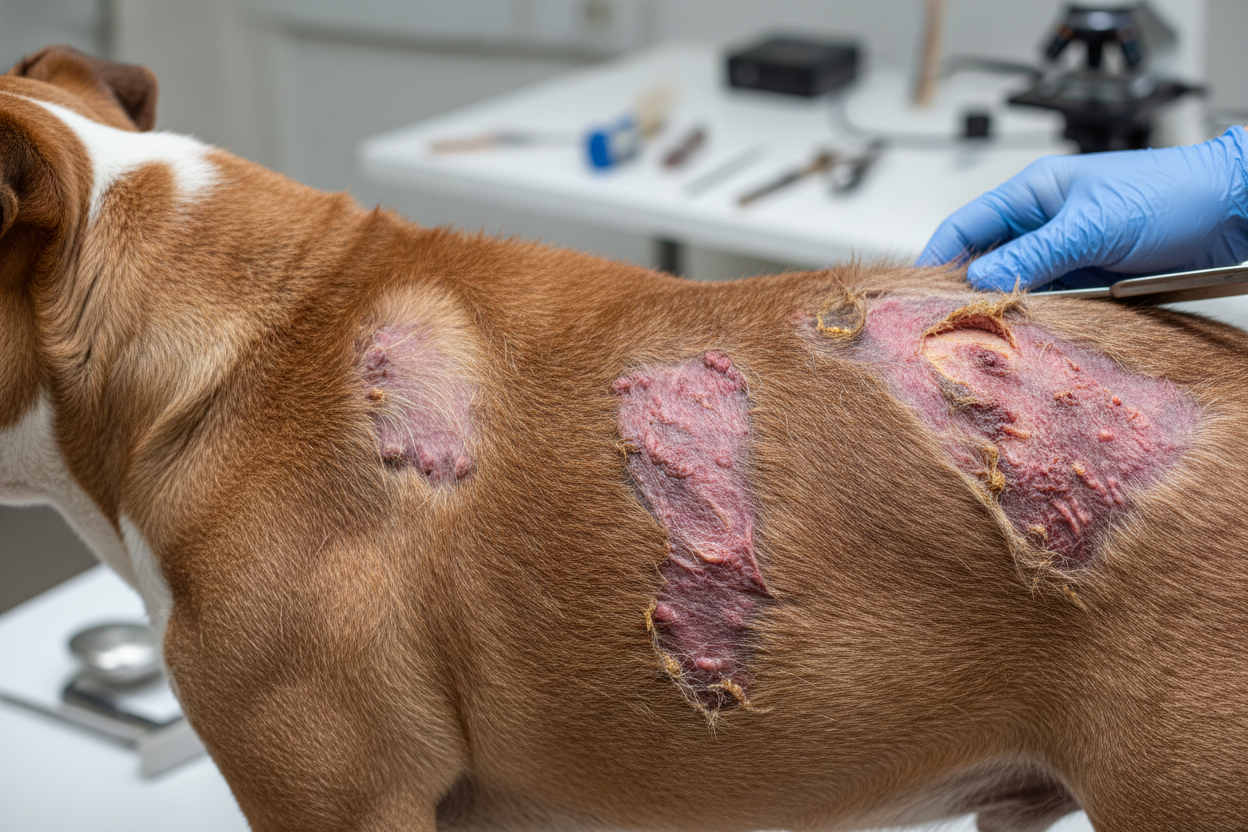
Beyond systemic effects, parabens are a known cause of contact dermatitis in sensitive individuals both human and animal. Repeated exposure can cause the immune system to become sensitised to the compound, leading to increasingly pronounced reactions over time. For a dog or cat already prone to itching or skin sensitivity, paraben-containing products may be quietly making things worse with every bath.
If your pet is showing signs of skin irritation after bathing, our guide to why dogs itch is worth reading.
They accumulate in the body
Parabens are not easily cleared. Studies have found them accumulating in fatty tissue and organs with repeated exposure. For a pet bathed regularly over many years, this cumulative effect is worth factoring into your product choices, even if any single exposure seems negligible.
Are parabens banned in pet products?
In the UK and EU, parabens are not banned in pet shampoos. Some longer-chain parabens (isobutylparaben and isopropylparaben) have been restricted or banned in cosmetics for humans in the EU, but these restrictions do not automatically extend to pet products. This means the burden falls on the consumer to check ingredient labels — including the hidden names listed above.
The precautionary principle... if in doubt, leave it out.... is a reasonable approach, particularly given how readily pet skin absorbs what's applied to it.
What should you use instead and why does the preservative choice matter for pet skin?
Parabens are not the only way to preserve a shampoo, but not all alternatives are equal either. The key question isn't just "does it work as a preservative?" it's how does it interact with the skin?
Parabens work by penetrating the skin and disrupting microbial cell activity systemically which is precisely why they end up in the bloodstream. A better approach for pet formulations is to use a preservative that works at the formulation level rather than the skin level, keeping the product safe without needing to penetrate the skin barrier to do so.
At FurBabies™ Botanicals, we use pentylene glycol as our preservation system in both shampoos and the choice was deliberate.
Pentylene glycol is a naturally derived, multifunctional ingredient (sourced from sugar cane) that preserves the formula by reducing the water activity that bacteria, mould, and yeast need to survive. It works in the formula itself, not by penetrating the skin barrier. It is not a xenoestrogen, is not an endocrine disruptor, and has a well-established safety profile in sensitive-skin formulations.
It also has a secondary benefit particularly relevant to pets: it is a humectant, meaning it helps draw moisture into the skin and supports the skin barrier — the opposite of what harsh chemical preservatives do. For a dog or cat with already-sensitive or reactive skin, this matters.
Our paraben-free shampoos
Both of our shampoos are completely paraben-free, preserved with pentylene glycol, pH-balanced for pet skin, and formulated with plant-derived surfactants that clean without stripping natural oils.
- Rinse-Off Shampoo for Sensitive, Itchy & Short-Haired Pets — ideal for dogs, cats, and rabbits with reactive or damaged skin. Fast-rinse formula with calming botanicals. Free from parabens, SLS, and synthetic fragrance.
- No-Rinse Shampoo Conditioner for Short-Haired Pets — for pets who find bathing stressful, or for a quick refresh between full washes. The same paraben-free, pentylene glycol-preserved formula without the need for rinsing.
Full ingredient lists are available on each product page — because we believe you should always know exactly what you're putting on your pet.
Parabens and SLS are often found together
It's worth noting that parabens frequently appear alongside other problematic ingredients — particularly SLS (Sodium Lauryl Sulphate) and SLES (Sodium Laureth Sulphate). If a shampoo contains parabens, there's a reasonable chance it also contains harsh surfactants. Our dedicated post on why to avoid SLS and SLES in pet shampoo explains the risks of those ingredients in detail.
Together, parabens and SLS represent the two most common ingredient concerns in mainstream pet shampoos. Avoiding both and understanding why is the foundation of choosing a product that genuinely supports your pet's long-term skin and coat health.
For the full picture on what makes a good pet shampoo, our pillar guide on whether the choice of shampoo really matters brings it all together.
Questions about ingredients or which FurBabies™ Botanicals product is right for your pet? Get in touch; we're always happy to help.
Share:
Why avoid Shampoos with SLS (Sodium Lauryl Sulphate) & SLES (Sodium Laureth Sulphate)
Is Xylitol Toxic to Dogs? What It Is, Where It's Found, and How to Check the Risk