
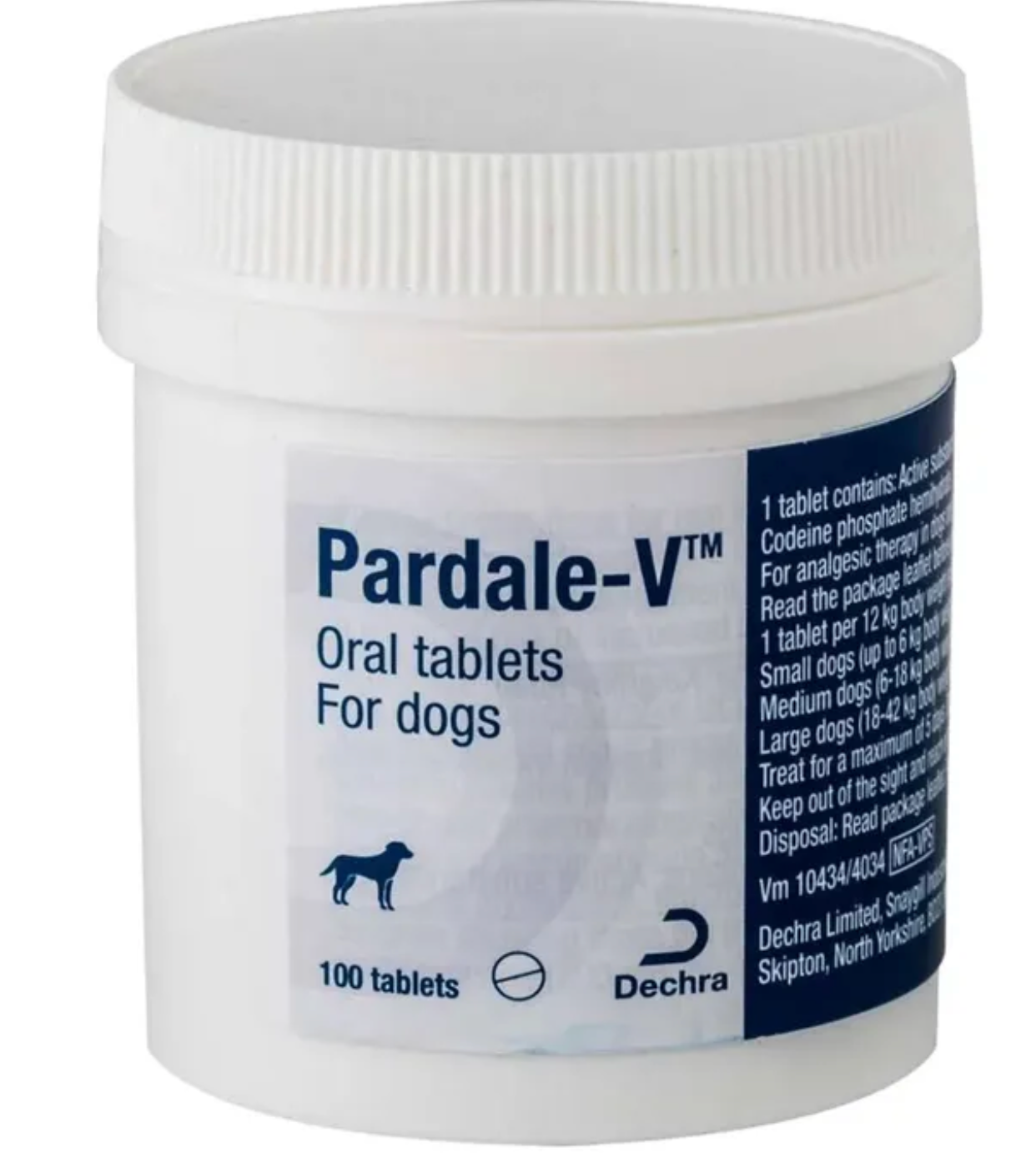
Pardale-V is the only veterinary medicine licensed in the UK that combines paracetamol (400mg) and codeine phosphate (9mg) in a single tablet for dogs. It is available on veterinary prescription only (POM-V), used for short-term mild to moderate pain relief, and must never be given to cats. The licensed dose is one tablet per 12kg of body weight, given every eight hours, for a maximum of five days.
What Pardale-V Contains and How It Works
Each Pardale-V tablet delivers two active ingredients working together. Paracetamol at 400mg acts on central pain pathways in the brain and spinal cord to reduce the perception of pain. Codeine phosphate at 9mg adds a mild opioid effect that amplifies that relief, producing better analgesia than either ingredient alone could achieve at the same doses.
It is manufactured and licensed exclusively for veterinary use in dogs. The formulation, dosing calculations, and excipients are specific to canine metabolism. This is not a reformulated human product. It is a distinct veterinary medicine, which is why your vet has prescribed it by name rather than pointing you toward a human pharmacy.
🐱 Never give Pardale-V to cats. Cats lack the liver enzyme pathway needed to safely break down paracetamol. Even a tiny fragment of a tablet can cause methaemoglobinaemia, a life-threatening condition where red blood cells lose the ability to carry oxygen. If you have cats and dogs sharing a home, store this medication with the same security as any prescription medicine.
Pardale-V Is Prescription-Only in the UK
Pardale-V is classified as a POM-V (Prescription Only Medicine — Veterinarian) by the UK Veterinary Medicines Directorate. It cannot be purchased over the counter at any pet shop, pharmacy, or legally operating online retailer in the UK. If you find it available without a prescription anywhere online, treat that as a serious red flag about the source and the product.
💡 Did you know? You have a legal right to ask your vet for a written prescription and use it at any registered veterinary pharmacy of your choice. Your vet is obliged to provide one on request. It often reduces the cost considerably and gives you full transparency over the batch number, manufacturer, and expiry date of what your dog is receiving.
When Vets Prescribe Pardale-V
Pardale-V is a short-term solution for situations where standard first-line veterinary painkillers such as meloxicam or carprofen are either insufficient or carry too much risk for an individual dog. Vets commonly prescribe it in these situations:
- Following soft tissue surgery where anti-inflammatory drugs pose a gastrointestinal or renal risk
- After acute musculoskeletal injuries such as sprains and strains
- Following trauma where fast, reliable analgesia is needed quickly
- In dogs who cannot tolerate NSAIDs due to gastric ulcers, kidney disease, or concurrent corticosteroid use
The treatment course is capped at five days by the licensed SPC. If pain persists beyond that point the clinical question changes entirely. Our guide to recognising pain signs in dogs and dog pain FAQs will help you have a more informed conversation with your vet about next steps.
Pardale-V vs Other Dog Painkillers
Meloxicam and carprofen are NSAIDs that reduce pain by targeting inflammation at the source. They are typically the first choice for musculoskeletal and post-operative pain because they are well-studied, highly effective, and available in palatable liquid or tablet form. The trade-off is that they carry gastrointestinal and renal risks, particularly with long-term use or in dogs with pre-existing conditions.
Pardale-V works differently. Paracetamol acts centrally rather than at the site of inflammation, and codeine adds an opioid layer on top. This makes it useful precisely in cases where NSAIDs are contraindicated or have not provided sufficient relief alone. It is not more powerful than NSAIDs across the board. It is a different mechanism, which is what makes it a valuable alternative rather than a direct competitor.
Pardale-V Dosing: The Exact Licensed Figures
The UK VMD Summary of Product Characteristics states the licensed dose as one tablet per 12kg of body weight, administered every eight hours, for a maximum of five days.
| Dog Weight | Dose Per Administration |
|---|---|
| Up to 6kg | Half a tablet |
| 12kg | 1 tablet |
| 24kg | 2 tablets |
| 36kg | 3 tablets |
Always follow your vet's specific instructions. These figures come directly from the official VMD SPC but your vet may adjust within this range based on your dog's individual health, concurrent medications, and pain severity.
🔬 Pharmacist's Note: Pardale-V tablets are not evenly scored for accurate half-dosing. When split, the paracetamol and codeine may not distribute evenly across both halves. For dogs under 8kg, where the margin between a therapeutic and a potentially toxic dose is already narrow, ask your vet whether the tablet format gives sufficient precision or whether an alternative analgesic would be safer.
Can Pardale-V Be Given With Food?
Yes, and it is generally advisable to do so. Giving Pardale-V with a small amount of food helps reduce the likelihood of gastrointestinal upset, which the codeine component can occasionally cause. It does not significantly affect the absorption of either active ingredient at the doses used in this formulation. If your dog is a reluctant pill-taker, wrapping the tablet in a small amount of food or a pill pocket is a practical and safe approach.
How Quickly Does Pardale-V Work?
Paracetamol reaches peak plasma concentration in dogs within approximately 30 to 60 minutes of oral administration. Codeine follows a similar absorption profile. Most owners notice an improvement in their dog's comfort level within one to two hours of the first dose. The effect of each dose typically lasts around six to eight hours, which aligns with the every-eight-hours dosing schedule.
If you are not seeing any meaningful improvement after 24 to 48 hours of correct dosing, contact your vet rather than continuing the course. Either the pain requires a different analgesic approach, or there is an underlying issue that needs reassessment.
What If I Miss a Dose?
Give it as soon as you remember, provided the next scheduled dose is not within two to three hours. If it is close to the time of the next dose, skip the missed one entirely and continue with the regular schedule. Never give two doses at once to make up for a missed one. Doubling up on paracetamol, even within the licensed daily range, increases the risk of accumulation in dogs with any degree of hepatic compromise.
What Most Pardale-V Articles Do Not Tell You About Codeine
Codeine does not relieve pain directly. It is a prodrug, meaning it has no meaningful activity until the body converts it into something else. Think of it as a locked door: the liver enzyme CYP2D6 is the key, and morphine is what is on the other side. Without that conversion completing efficiently, the codeine component simply does not work.
🧬 Why some dogs get less benefit from Pardale-V. A proportion of dogs are poor CYP2D6 metabolisers. Their livers do not efficiently convert codeine into morphine, meaning the opioid component produces little to no pain relief in those animals. The paracetamol continues working, but the combination benefit is lost. If your dog is not responding as expected at the correct dose, this is worth raising with your vet before assuming the prescription needs changing.
Side Effects of Pardale-V in Dogs
At therapeutic doses Pardale-V is generally well tolerated in healthy dogs. The codeine component can cause mild constipation, particularly with repeated dosing over several days. Some dogs experience mild sedation or drowsiness, which is a normal low-dose opioid effect and not in itself a cause for alarm unless it is pronounced or accompanied by other symptoms. Occasional vomiting and nausea are also reported, which is why giving the tablet with food is a sensible precaution.
Paracetamol at the licensed dose is well tolerated in healthy dogs, but any pre-existing liver compromise increases the risk profile significantly. Dogs with known hepatic conditions should not receive Pardale-V without explicit veterinary assessment.
If you notice significant lethargy, loss of appetite, persistent vomiting, or any change in the colour of your dog's gums, contact your vet before continuing the course.
Pardale-V and Phenobarbitone: What Epileptic Dog Owners Must Know
⚠️ If your dog takes phenobarbitone for epilepsy, read this before giving the first dose. Phenobarbitone is a potent inducer of cytochrome P450 liver enzymes. It accelerates the breakdown of paracetamol into NAPQI, the toxic metabolite responsible for liver damage and red blood cell injury. In a dog whose liver enzymes are already significantly upregulated, a standard licensed dose of Pardale-V may generate NAPQI faster than the liver can safely neutralise it, even though the dose sits within the licensed range for a healthy dog. This interaction is documented in the veterinary pharmacology literature but is rarely mentioned in accessible pet health content. Ask your vet directly whether they have accounted for this interaction before giving the first dose.
Recognising Paracetamol Overdose in Dogs
This is the section you hope you never need. Read it now so you are not trying to find it in a crisis.
Paracetamol has a narrower safety margin in dogs than most owners appreciate. Research confirms that in dogs, overdose primarily causes methaemoglobinaemia and haemolysis rather than the liver-dominant toxicity seen in humans, though liver damage also occurs at higher doses. A single standard 500mg human paracetamol tablet given to a 5kg dog delivers exactly 100mg/kg, sitting at the threshold of toxicity.
Signs develop progressively:
- Early: Lethargy, weakness, vomiting
- Developing: Pale, grey, or bluish gums (cyanosis), rapid or laboured breathing, facial or paw swelling
- Late (24 to 72 hours): Jaundice, yellowing of skin or whites of eyes, indicating liver involvement
- Severe: Collapse
🚨 Emergency: Suspected paracetamol overdose. Contact your vet or the Animal Poison Line immediately on 01202 509000. Do not wait for symptoms to develop. The treatment window for N-acetylcysteine, which neutralises the toxic metabolite before it causes irreversible damage, is time-critical. Our article on human paracetamol and dogs covers the full picture.
Why Human Co-Codamol Is Not a Substitute
Human co-codamol tablets contain 500mg of paracetamol, significantly more than the entire paracetamol content of a Pardale-V tablet, alongside codeine at 8mg or 30mg depending on the formulation. They are not licensed for veterinary use, the excipients have not been validated for canine metabolism, and the paracetamol load creates a serious overdose risk particularly in smaller dogs. If you cannot access Pardale-V, call your vet. Not a human pharmacy.
Storage, Handling, and Disposal
Store Pardale-V below 25 degrees Celsius in the original packaging, away from light and moisture. Keep it out of reach of children and other pets at all times.
Do not dispose of unused tablets in household waste or flush them down the sink. Return any unused medication to your veterinary practice or a registered pharmacy for safe disposal. This is a legal requirement for veterinary prescription medicines in the UK.
Breeding, Pregnant, and Lactating Dogs
The licensed SPC advises that the safety of Pardale-V has not been established in pregnant or lactating dogs, or in dogs intended for breeding. Use should only be considered when the clinical benefit to the mother clearly outweighs the potential risk. If your dog is pregnant, recently whelped, or you are planning to breed from her, discuss this explicitly with your vet before any paracetamol-containing product is prescribed.
Long-Term Pain in Dogs: Where Pardale-V Ends
Pardale-V is well-designed for what it is licensed to do. The harder question is what comes next for dogs living with chronic joint pain, age-related stiffness, or the progressive deterioration of osteoarthritis. Long-term NSAID use carries cumulative risks to the kidneys, liver, and gastrointestinal lining. Pardale-V is not an option for ongoing use at all. There is a real gap in conventional veterinary medicine between the acute treatment phase and truly sustainable long-term pain management, and it is precisely that gap that led me to found FurBabies™ Botanicals.
Our Aches and Pains Rub for Dogs and Cats is a topical formulation for localised joint and muscle discomfort. The full natural pain relief for dogs guide walks through the evidence behind green-lipped mussel, Boswellia serrata, and turmeric with black pepper. For older dogs, the piece on sarcopenia and chronic pain in senior dogs addresses the muscle loss that compounds joint pain with age. Our quality of life framework and dog weight guide are also worth bookmarking.
Disclaimer: This article has been written by a UK-registered pharmacist for general informational and educational purposes only. It does not constitute veterinary advice and is not a substitute for professional veterinary consultation, diagnosis, or treatment. Always seek the guidance of a qualified veterinary surgeon regarding any questions you may have about your pet's health, medication, or medical condition. Never disregard professional veterinary advice or delay seeking it because of something you have read in any article. The information provided reflects the licensed Summary of Product Characteristics and peer-reviewed literature available at the time of writing and is subject to change. FurBabies™ Botanicals and its founder accept no liability for any loss, injury, or damage arising from reliance on the content of this article. Product recommendations within this article relating to FurBabies™ Botanicals are included for informational purposes and should be discussed with your veterinary surgeon before use. This article is intended for a UK audience only. Licensing, dosing, and legal requirements for veterinary medicines differ between countries.
The Pharmacist's Summary
✅ Quick checklist before you start:
- Give with food to reduce nausea
- Every 8 hours, maximum 5 days
- Never combine with any other paracetamol-containing product
- If your dog is under 8kg, ask about tablet splitting accuracy
- If your dog takes phenobarbitone, confirm the NAPQI interaction has been considered
- Ask your vet for a written prescription you are entitled to one
- Keep out of reach of cats at all times
The acute phase is where Pardale-V earns its place. What comes after, the sustained and intelligent support for a dog living with ongoing discomfort, is what FurBabies™ Botanicals was built to provide.
References
- Veterinary Medicines Directorate. Pardale-V 400mg/9mg Tablets, Summary of Product Characteristics. January 2026. vmd.defra.gov.uk
- Veterinary Medicines Directorate. Currently Authorised Veterinary Products. vmd.defra.gov.uk
- MSD Veterinary Manual. Hepatotoxins in Small Animals. Updated September 2024. msdvetmanual.com
- McConkey SE, Grant DM, Cribb AE. Para-aminophenol in acetaminophen-induced methemoglobinemia in dogs and cats. J Vet Pharmacol Ther. 2009;32(6):585-95. pubmed.ncbi.nlm.nih.gov
- Savides MC et al. Toxicity and biotransformation of acetaminophen in dogs and cats. Toxicol Appl Pharmacol. 1984;74(1):26-34.
- NIH/NCBI. Codeine Therapy and CYP2D6 Genotype. ncbi.nlm.nih.gov
- Crews KR et al. CPIC guidelines for CYP2D6 and codeine therapy. Clin Pharmacol Ther. 2012;91(2):321-6.
- Maddison JE, Page SW, Church DB. Small Animal Clinical Pharmacology. 2nd ed. Saunders Elsevier; 2008.
- Animal Poison Line UK. 01202 509000. animalpoisonline.co.uk





Share:
Dog Collar vs Harness: The Neck Damage Most Owners Don't Know About
What flea treatment do vets use?