
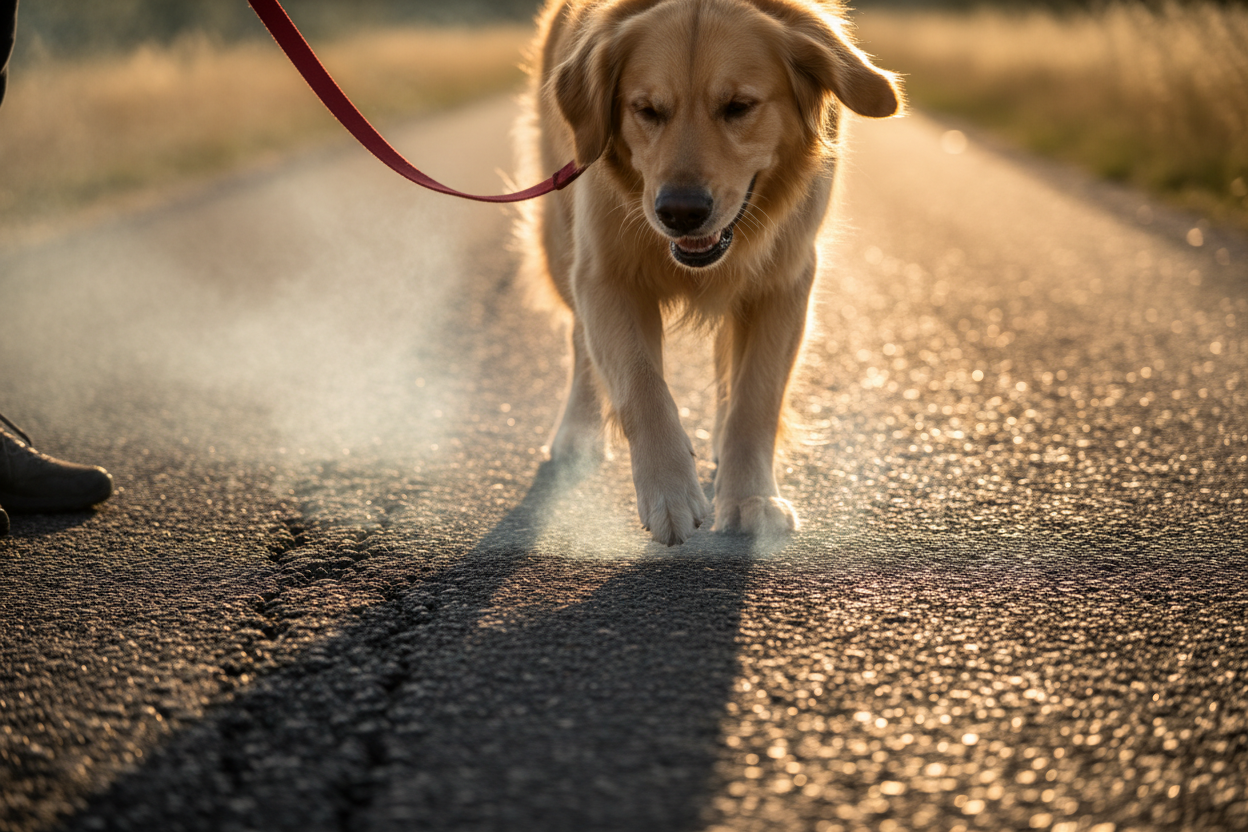
At an air temperature of 25 degrees Celsius, UK tarmac and asphalt pavement surfaces reach 52 degrees Celsius. At 31 degrees Celsius, pavement reaches 62 degrees Celsius. Skin tissue destruction begins in under one minute at 52 degrees Celsius. In the UK in summer 2026, walking your dog at the wrong time of day is one of the most common and entirely preventable causes of paw pad burns, heatstroke, and joint injury in dogs.
In the UK, it is too hot to walk your dog when air temperature exceeds 24 degrees Celsius, when pavement fails the seven-second hand test, or when humidity exceeds 60 percent. At 25 degrees Celsius, tarmac reaches 52 degrees Celsius and can cause paw pad burns within one minute. This guide, written by a UK-registered pharmacist using Royal Veterinary College data, covers the exact temperature thresholds by breed, the safest times of day, and what to do if your dog overheats mid-walk.
In summer 2026, with the UK experiencing record June temperatures, every one of these queries has reached breakout search status: "is it too hot to walk my dog today," "how hot is too hot to walk a dog," "what temperature is too hot to walk a dog UK," and "heat stroke in dogs." This article answers all of them.
The UK Temperature Guide: Is It Safe to Walk Your Dog Today?
This table is based on the Vets Now clinical temperature risk assessment, verified against veterinary guidance from the Royal Veterinary College and Insight Britain's 2026 veterinary review.
| Air Temperature | Risk Level | Guidance |
|---|---|---|
| Below 19°C | Low | Generally safe for most dogs. Monitor flat-faced and overweight breeds even at lower temperatures |
| 20°C to 23°C | Moderate | Safe for short walks in most dogs. Avoid midday. Carry water. Flat-faced breeds need extra caution at this range |
| 24°C to 27°C | High | Limit walks to before 8am or after 8pm. Keep duration under 30 minutes. Always do the pavement test first |
| 28°C to 31°C | Very High | Avoid walks for all but essential toilet breaks. Brachycephalic, elderly, and overweight dogs face serious danger at this range |
| 32°C and above | Extreme | No walks. Keep dogs indoors with fans or air conditioning. Heatstroke can develop even at rest indoors without adequate cooling |
The optimal temperature window for dog walks, where heatstroke risk is effectively zero for most breeds, is between 5 and 15 degrees Celsius. In a UK summer heatwave, early morning before 8am or after sunset are the only genuinely safe windows on high-temperature days.
The Seven-Second Pavement Test
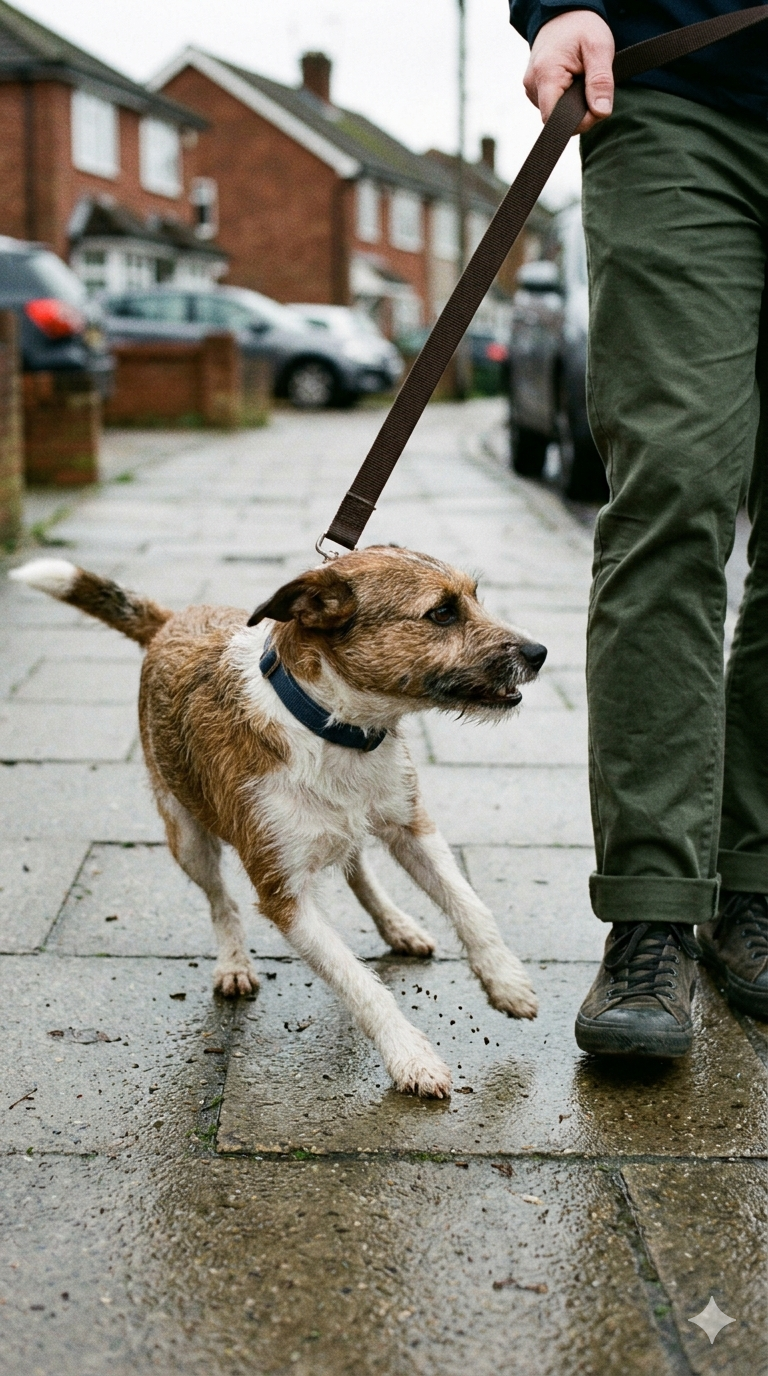
Do this before every walk when air temperature is above 20 degrees Celsius. Place the back of your hand flat on the pavement surface. Hold it there for seven seconds. If you cannot hold it for the full seven seconds because of the heat, the surface is too hot for your dog's paw pads.
Here is why surface temperature matters more than air temperature alone. When air temperature is 25 degrees Celsius, tarmac reaches 52 degrees Celsius. At 31 degrees Celsius air temperature, tarmac reaches 62 degrees Celsius. Research published in the Annals of Emergency Medicine confirmed that skin tissue destruction begins in under one minute at 52 degrees Celsius. Your dog is walking barefoot on that surface for the entire duration of the walk.
Different surfaces behave very differently. Artificial grass is the most dangerous surface of all, regularly exceeding 50 degrees Celsius at peak afternoon heat. Running track material and asphalt follow. Brick and concrete retain significant heat. Natural grass is substantially cooler. If you must walk during warm weather, choose grass routes, woodland paths, or shaded dirt tracks over pavements wherever possible.
Which Dogs Are at Highest Risk
Not all dogs face equal risk at the same temperature. A landmark study by VetCompass at the Royal Veterinary College, published in Vet Record in 2024, analysed 167,751 dogs in emergency veterinary care during the UK summer of 2022 and produced the following breed risk data relative to a Labrador Retriever as baseline.
| Breed | Relative Heatstroke Risk |
|---|---|
| Newfoundland | 15.5 times higher than a Labrador |
| Chow Chow | 11.5 times higher |
| English Bulldog | 11.1 times higher |
| French Bulldog | 6 times higher |
| Pug | 4.6 times higher |
| Pomeranian | 4.6 times higher |
| Staffordshire Bull Terrier | 4.6 times higher |
Brachycephalic breeds as a group had 4.21 times the heatstroke risk of dogs with a normal skull shape. Over half of all heatstroke cases in the study, 51.5 percent, were triggered by exercise rather than confinement. The median ambient air temperature on days when UK dogs developed heat-related illness was just 16.9 degrees Celsius, confirming that UK dogs are not failing at temperatures that feel extreme. They are failing at temperatures their owners consider mild.
Beyond breed, the dogs at highest additional risk include those that are overweight or obese, those over seven years of age, those with pre-existing heart or respiratory conditions, and any dog that has not had gradual exposure to warmer temperatures during the weeks preceding a heatwave.
Humidity: The Factor Most Owners Overlook
Panting is how dogs cool themselves through evaporation of moisture from the tongue and upper airways. High ambient humidity reduces the efficiency of this mechanism directly, because humid air has reduced capacity to absorb further moisture. Humidity above 60 percent significantly hampers panting efficiency. On a humid day, an air temperature of 22 degrees Celsius can present a similar physiological challenge to your dog as 27 degrees Celsius on a dry day.
Always check both temperature and humidity before deciding whether to walk. Most UK weather apps display humidity. A heat index combining both figures gives a more accurate picture of the actual risk than air temperature alone. If it feels oppressively muggy to you, your dog's cooling system is working significantly harder than the thermometer reading suggests.
What Time of Day Is Safe to Walk Your Dog in a UK Summer
Vets Now and the RSPCA both advise walking between 8pm and 8am during heatwaves. The specific reason is that tarmac and asphalt retain heat from the afternoon sun well into the evening. A surface that reached 62 degrees Celsius at 2pm may still be above 40 degrees Celsius at 6pm. A 7pm evening walk during a UK heatwave is not safe for paw pads regardless of how comfortable the air feels to you.
In the morning, walk before 9am. Surface temperatures begin rising quickly once the sun is at full strength, typically from 10am onward. The period between 11am and 3pm carries the highest combined risk from surface temperature, UV index, and ambient heat and should be avoided entirely when air temperatures exceed 24 degrees Celsius. Shifting your walk by even 60 minutes earlier in the morning or later in the evening makes a significant and measurable difference to the risk.
Signs Your Dog Is Getting Too Hot on a Walk
Stop the walk immediately and move to shade and cool water if you observe any of the following. Excessive or unusually loud panting that is not settling as the pace reduces. Heavy drooling or thick, stringy saliva rather than normal light panting drool. Slowing down significantly, lagging behind, or an unexpected reluctance to continue walking. Bright red, very dark, or unusually pale gums or tongue. Glassy, unfocused, or glazed eyes. Stumbling, hindleg weakness, or any loss of coordination. Vomiting or retching during or immediately after the walk.
A dog's normal core body temperature is between 38.3 and 39.2 degrees Celsius. Heatstroke is clinically defined as a core temperature above 41 degrees Celsius. At temperatures between 41.2 and 42.7 degrees Celsius, multiple organ failure becomes a critical and rapidly escalating risk. This progression from mild overheating to organ failure can occur within minutes in a vulnerable dog. Do not wait to see if the dog improves on its own.
What to Do If Your Dog Overheats During a Walk
Act immediately. Do not wait for symptoms to worsen.
Move to shade immediately and stop all exercise. Apply cool water, not cold or iced, to the paw pads, groin, armpits, and the back of the neck. Lukewarm water applied with a wet cloth is preferable to pouring ice water over the dog, as extreme cold causes peripheral vasoconstriction which can trap heat in the core rather than allowing it to dissipate. Offer small amounts of cool water to drink but do not force it. Use a fan or create airflow if possible, as it is the evaporation of water from the skin that produces cooling, not the water temperature alone.
Once the dog has fully cooled, inspect the paw pads for redness or surface damage. Our Paw, Wrinkle and Nose Balm supports recovery and everyday paw pad care after heat exposure.
Call your vet or emergency vet immediately even if the dog appears to be recovering. Internal organ damage from heatstroke can be present and progressing before external signs resolve. Do not put the dog in a cold bath or apply ice packs directly to the skin.
In a life-threatening emergency, go directly to your nearest emergency veterinary practice without waiting to call ahead.
Why Dogs in Spain Handle the Heat But Your UK Dog Cannot: The Acclimatisation Science
This is the most common and most reasonable challenge to summer walking guidance, and the science behind it is genuinely worth understanding. The short answer is this: dogs in hot climates are not simply tougher. They are physiologically different as a result of a documented biological process called heat acclimatisation, and it requires weeks to begin and multiple seasons to develop fully.
What Acclimatisation Does to a Dog's Body
Peer-reviewed research confirms that dogs exposed to heat gradually over time develop measurable and protective physiological changes. The core body temperature threshold at which panting begins shifts lower in acclimatised dogs, meaning they start their cooling mechanism before they are already in danger rather than in response to it. Research published in the Journal of Applied Physiology found that heat-acclimatised dogs retain fluid preferentially within the intravascular space during heat stress, expanding plasma volume and maintaining cardiovascular function more effectively than non-acclimatised dogs. A two-year study of military working dogs in hot climates found progressively increasing expression of heat shock proteins with combined heat and exercise exposure, representing cellular-level protection against thermal damage that develops over years of repeated exposure. A 2025 Frontiers in Animal Science review confirmed that seasonal acclimatisation in dogs produces measurable physiological differences between dogs living in consistently hot versus consistently cool climates.
Why This Does Not Apply to Your UK Dog Right Now
Acclimatisation to heat in mammals requires a minimum of 10 to 14 consecutive days of heat exposure to begin producing measurable physiological changes, and full adaptation develops across multiple seasons. A UK dog in June 2026 has spent the preceding eight months at temperatures between 4 and 16 degrees Celsius. Their panting threshold, plasma volume regulation, and cardiovascular heat response are all calibrated for a cool climate. When air temperature jumps from 16 degrees Celsius in May to 31 degrees Celsius in a June heatwave, the dog's physiology has had no time to adapt. This is directly confirmed by the Royal Veterinary College VetCompass data: the median ambient air temperature on days UK dogs developed heat-related illness was just 16.9 degrees Celsius. UK dogs are not failing at temperatures a Spanish dog would find comfortable. They are failing at temperatures their owners consider mild.
The Surface Problem That Acclimatisation Cannot Solve
A dog in Spain or a Mediterranean coastal area is typically walking on sand, soil, dirt tracks, or limestone, all of which are natural surfaces that behave within the range mammalian paw pad tissue was designed to tolerate. UK tarmac and asphalt are human-made materials that reach 52 to 62 degrees Celsius on hot days. No biological acclimatisation process produces paw pad tissue capable of tolerating these temperatures. This is a materials science problem, not a biology problem. The argument that dogs are naturally designed for heat does not address what British road surfaces do that natural terrain never does.
Cooling Products: What the Evidence Actually Says
The UK market for dog cooling products has grown dramatically in summer 2026, with cooling mat and cooling vest searches up over 200 percent in the past three months. Here is an honest, clinically grounded assessment of what works, what is overstated, and what carries a genuine caution.
Evaporative Cooling Vests: Genuinely Effective With Caveats
Evaporative cooling vests work on the same physiological principle as panting: water evaporates from the fabric surface and draws heat away from the body. A peer-reviewed 2022 clinical study found that dogs wearing evaporative cooling vests after exercise in heat had measurably lower body temperatures than dogs with no vest. A University of Florida veterinary study confirmed that properly designed cooling vests helped dogs cool down faster post-exercise and found no evidence that vest-wearing caused additional overheating. The vest must be wet to work. A dry cooling vest provides no benefit and must be rewetted regularly during use. An evaporative vest cannot make a hot pavement safe for paw pads, cannot replace shade and water, and does not make it safe to walk during peak heat hours. It reduces heat stress at the margins during unavoidable activity.
Ice Vests and Ice Packs: Use With Caution
Ice vests and direct application of ice to a dog's skin carry a specific clinical concern. In active heatstroke treatment, extreme cold applied to the skin surface causes peripheral vasoconstriction, where blood vessels near the surface contract, which can slow the rate at which the body's core temperature falls. This is the same clinical reason veterinary guidance consistently recommends lukewarm water rather than ice water for cooling an overheated dog. For preventative use during walks rather than active heatstroke treatment, the risk is lower but the benefit is also less than evaporative cooling. Dogs with joint conditions may find ice vests uncomfortable. If using a product with ice packs, ensure there is always a fabric barrier between the pack and your dog's skin.
Cooling Mats: Genuinely Useful Indoors
Cooling mats have a well-supported role as indoor resting surfaces. The Veterinary Poisons Information Service confirmed that the gel inside pressure-activated cooling mats is generally non-toxic, comprising sodium sulphate, cellulose, and water. The primary safety risk is a dog chewing through the mat and ingesting large pieces, which carries a risk of intestinal obstruction rather than toxicity. If your dog is a chewer, choose a mat with a more durable outer cover or supervise use. Pressure-activated gel mats are most effective as a cool resting surface at home, in crates, and in cars during travel, not as active cooling devices during exercise.
Cooling Bandanas: Limited Evidence, Low Risk
Cooling bandanas are widely marketed but have the weakest evidence base of all products in this category. A damp bandana around the neck may provide minor evaporative cooling over the jugular vein but the surface area is minimal. They are not harmful and may provide marginal comfort but should not be relied upon as a meaningful cooling strategy in high temperatures.
"No product replaces the fundamentals: walk before 8am or after 8pm, test the pavement, carry water, and know your breed's risk level. Cooling products reduce heat stress at the margins during unavoidable activity. They do not make unsafe walking conditions safe."
The Hidden Consequence: Hot Weather Walks and Joint Damage
Walking a dog with existing joint disease or subclinical arthritis on hot pavement creates a compounding injury. Heat increases systemic inflammation. Dehydration during a warm walk reduces synovial fluid in the joints, reducing lubrication at exactly the moment mechanical stress is highest. Hard pavement surfaces increase the impact load on joints compared to grass or soil. The result is a dog that may appear outwardly fine during the walk but pants heavily afterward, not from heat alone but from a combination of heat stress and pain.
Barometric pressure drops before summer thunderstorms have also been documented to worsen arthritic pain in dogs, meaning your dog may be in more pain on a humid, pre-storm summer day than on a cold winter morning. If your dog is consistently panting after walks in warm weather, the cause may not be heat alone. Read our complete guide to Why Is My Dog Panting So Much? for the full clinical differential including arthritis, Cushing's disease, and cardiac causes.
For dogs with existing musculoskeletal discomfort, our Aches and Pains Relief Rub for Hips, Joints and Muscles provides topical botanical support formulated to be safe on canine skin with no parabens, no SLS, and no synthetic fragrance.
Skin and Paw Pad Care After Hot Weather Walks
Paw pads can sustain thermal damage even when the dog shows no immediate signs of distress. Dogs' pain responses are stoic and muted, particularly in breeds bred for working or guarding. After any walk in warm conditions, inspect the paw pads for redness, cracking, peeling, or unusual sensitivity when touched. Check between the toes for redness or moisture, as hot and humid weather accelerates yeast overgrowth in interdigital spaces.
If your dog is licking their paws excessively after warm weather walks, this is a common early sign of skin inflammation, yeast overgrowth, or contact irritation from hot surfaces. Our Multipurpose Itch, Hotspot and Yeast Balm is formulated for exactly this presentation and is safe for regular topical use on dogs.
For everyday paw pad nourishment, deep conditioning, and repair after hot weather walks, our Avocado, EFA and Ceramide Nose, Wrinkle and Paw Ointment is formulated to restore and protect dry, cracked, or heat-stressed paw pad tissue. Regular application after warm weather walks supports the skin barrier before soreness and cracking develop.
Indoor Alternatives on Days That Are Too Hot to Walk
Dogs still require mental stimulation on days when outdoor walks are not safe. Without it, frustration and anxiety build, which paradoxically can increase panting through cortisol release even indoors. Puzzle feeders and sniff mats engage natural foraging instincts and tire dogs mentally without physical exertion. Short indoor training sessions of five to ten minutes maintain routine and provide cognitive engagement. Hide-and-seek games in the house are highly effective for scent-driven breeds. A paddling pool in a shaded garden section provides physical activity and active cooling simultaneously, though apply the seven-second rule to any garden surface before letting your dog lie or sit on it.
Car Safety: A Brief but Critical Note
A car parked at an external temperature of 22 degrees Celsius can reach 47 degrees Celsius internally within minutes, even with windows open and even in shade. Leaving a dog unattended in a vehicle is not a specific criminal offence in the UK, but owners can be prosecuted under the Animal Welfare Act 2006 if their dog suffers or dies as a result. The RSPCA advises never leaving a dog in a car in warm weather under any circumstances, regardless of duration.
Frequently Asked Questions
Is 25 degrees Celsius too hot to walk my dog in the UK?
Yes, for most dogs 25 degrees Celsius air temperature is a high-risk rating. The greater danger at this temperature is the pavement surface, which reaches 52 degrees Celsius. Apply the seven-second pavement test before any walk. If you cannot hold your hand on the surface for seven seconds, do not walk your dog on it. Before 8am and after 8pm are the safe windows at this temperature.
What is the safest time to walk a dog in a UK summer?
Before 8am and after 8pm according to Vets Now clinical guidance. In a heatwave, after 9pm is safer still as surfaces continue releasing stored heat into the early evening. The most dangerous period is between 11am and 3pm.
Can my dog walk on grass when it is too hot for pavement?
Yes. Natural grass is substantially cooler than tarmac, asphalt, brick, or artificial grass. A shaded grass route, woodland path, or dirt track is a significantly safer option when air temperatures are between 20 and 27 degrees Celsius.
But dogs in Spain and hot countries walk in the heat all day. Why is my UK dog different?
Because acclimatisation is a real physiological process that requires weeks to develop and multiple seasons to complete. A dog in Spain has gradually adapted over months and years, developing a lower panting threshold, better cardiovascular heat response, and cellular heat protection. Your UK dog has spent eight months in temperatures between 4 and 16 degrees Celsius and has had no time to develop these adaptations. The Royal Veterinary College found UK dogs developing heatstroke at a median air temperature of just 16.9 degrees Celsius. Additionally, dogs in hot countries walk on sand, soil, and natural surfaces, not on tarmac that reaches 62 degrees Celsius. No acclimatisation process produces paw pads capable of tolerating that surface temperature.
My dog seems fine during the walk but pants heavily afterwards. Is this normal?
Some post-exercise panting is expected. If it is intense, prolonged beyond 15 minutes, or occurring at rest after the dog has cooled down, it may signal heat stress, pain, or joint inflammation rather than simple temperature regulation. Read Why Is My Dog Panting So Much? for the full clinical differential.
Is my overweight dog at higher risk in hot weather?
Yes, significantly. Excess body fat insulates heat and the cardiovascular system must work harder per unit of exertion. Overweight dogs overheat faster, cool down slower, and are at substantially higher risk of heatstroke. Read Is My Dog Too Fat? for the body condition scoring guide.
What temperature causes heatstroke in dogs?
Heatstroke is clinically defined as a core body temperature above 41 degrees Celsius. A dog's normal resting temperature is 38.3 to 39.2 degrees Celsius. The margin between normal and dangerous is narrow. Multiple organ failure risk begins at approximately 41.2 to 42.7 degrees Celsius and can progress within minutes. This is why early recognition and immediate action matter more than waiting to confirm the diagnosis.
How long does it take for a dog to acclimatise to hot weather?
A minimum of 10 to 14 consecutive days of gradual heat exposure is required before measurable physiological changes begin. Full acclimatisation develops across multiple seasons of repeated exposure. A single hot week in the UK is not sufficient for acclimatisation. Do not assume your dog has adapted simply because the hot weather has lasted a few days.
Clinical References
- Harrington WZ et al. Pavement Temperature and Burns: Streets of Fire. Annals of Emergency Medicine. 1995;26(5):563–568.
- Hall E et al. Epidemiology of heat-related illness in dogs under UK emergency veterinary care in 2022. Vet Record. Royal Veterinary College VetCompass. 2024.
- VetCompass at the Royal Veterinary College. Risk Factors for Severe and Fatal Heat-Related Illness in UK Dogs. Veterinary Sciences. 2022;9(5):231.
- Bruchim Y et al. Pathophysiology of heatstroke in dogs: revisited. Journal of Veterinary Internal Medicine. 2017. PMC5800390.
- Moran DS et al. Two years of combined high-intensity physical training and heat acclimatization in military working dogs. Journal of Applied Physiology. 2014.
- Gershoff SN et al. Effect of plasma volume on thermoregulation in the dog. Journal of Applied Physiology. 1983;55(2).
- Frontiers in Animal Science. Heat stress in domestic dogs: morphological and environmental risk factors. 2025.
- Veterinary Poisons Information Service. Cooling mats for pets. 2020.
- VCA Animal Hospitals. Heat Stroke in Dogs. Clinical reference.
- RSPCA UK. Caring for your dog in hot weather. 2025.
- Four Paws UK. Hot Tarmac: A Danger to Your Dog's Paws. 2025.
- Vets Now UK. Clinical temperature risk guidance for dog walking in hot weather. 2024.
Related Reading
- Why Is My Dog Panting So Much? A Pharmacist's Complete Guide
- Natural Pain Relief for Dogs
- Signs of Arthritis in Dogs
- Why Do My Dog's Joints Click?
- Is My Dog Too Fat?
- Why Is My Dog Itching?
- Does My Dog Have a Good Quality of Life?
Written by a UK-registered pharmacist and pet product formulator. All content is provided for educational purposes and does not constitute veterinary advice. Always consult a registered veterinary surgeon for diagnosis and treatment of your pet. FurBabies Botanicals | myfurbabies.co.uk
Share:
Why Is My Dog Panting So Much? A Pharmacist's Complete Guide (UK 2026)
Best Pet Insurance UK 2026: Compare Top 10 Providers for Dogs & Cats