

Yes! dogs catch cat fleas routinely, and this is not an unusual edge case. In the UK, the vast majority of flea infestations in both cats and dogs are caused by a single species: Ctenocephalides felis, the cat flea. Despite its name, C. felis is an opportunistic parasite that feeds equally well on dogs, cats, foxes, rabbits, and other mammals. If your dog has fleas, the overwhelming probability is that they have cat fleas. The distinction between "cat fleas" and "dog fleas" is taxonomically meaningful but clinically largely irrelevant for most pet owners — what matters is that fleas transfer freely between dogs and cats in any shared environment, and treatment must account for both animals and the home simultaneously.
Jump to a Section
- Cat fleas vs dog fleas — the actual difference
- How to tell them apart visually
- How fleas transfer between cats and dogs
- Flea allergy dermatitis — why the same flea affects animals differently
- Disease risks from flea transmission
- Treating a multi-pet household
- Prevention in homes with both cats and dogs
Cat Fleas vs Dog Fleas — What Is the Actual Difference?
Ctenocephalides felis (the cat flea) and Ctenocephalides canis (the dog flea) are two distinct species within the same genus. Both are small, laterally flattened, wingless insects that feed on mammalian blood. They are distinguished morphologically by the shape of the head and the proportions of the genal comb (the row of spine-like projections on the head), and cannot be reliably distinguished by the naked eye — differentiation requires microscopic examination.
The clinically critical point, established by multiple UK and European entomological studies, is that C. felis accounts for approximately 90–95% of all flea infestations identified from dogs and cats in the UK and Western Europe (Rust & Dryden, 1997; Beugnet et al., 2014). C. canis, the true dog flea, exists but is genuinely uncommon in UK households. When a vet or pharmacist refers to "fleas" on your dog or cat in the UK, they are almost always referring to C. felis. Both species respond to the same treatments — the practical management is identical regardless of species.
Flea Species Found in UK Homes
| Species | Common Name | Primary Host(s) | Frequency in UK Pet Homes | Infests Dogs? | Infests Cats? |
|---|---|---|---|---|---|
| Ctenocephalides felis | Cat flea | Cats, dogs, foxes, rabbits | Very common — ~90–95% of infestations | Yes | Yes |
| Ctenocephalides canis | Dog flea | Dogs, foxes | Uncommon | Yes | Occasionally |
| Pulex irritans | Human flea | Humans, pigs, foxes | Rare in modern UK homes | Occasionally | Occasionally |
| Spilopsyllus cuniculi | Rabbit flea | Rabbits | Uncommon — associated with rabbit ownership or wildlife contact | Occasionally | Occasionally |
| Archaeopsylla erinacei | Hedgehog flea | Hedgehogs | Rare — garden exposure | Rarely | Rarely |
| Echidnophaga gallinacea | Sticktight flea | Poultry, birds | Rare — rural properties with poultry | Occasionally | Occasionally |
How to Tell Cat Fleas and Dog Fleas Apart
As noted above, reliable species-level identification requires microscopic examination. However, the two most common species do have morphological differences that a trained eye can sometimes detect on close inspection:
Head of a Dog Flea (C. canis) — rounded head, shorter genal comb, shorter abdomen

Head of a Cat Flea (C. felis) — longer, more elongated head, longer genal comb, longer abdomen

| Feature | Cat Flea (C. felis) | Dog Flea (C. canis) |
|---|---|---|
| Head shape | Elongated, longer than wide | Rounded, approximately as wide as tall |
| Genal comb | Longer, more pronounced | Shorter |
| Pronotal comb | Present | Present |
| Body length (adult) | 1–3 mm | 1.5–4 mm |
| Colour | Reddish-brown | Dark brown to black |
| Abdomen length | Longer relative to body | Shorter relative to body |
In practice, the colour difference (reddish-brown vs darker brown-black) and the head profile are the most useful naked-eye features, but both species are very small and move rapidly through the coat. Neither colour nor size alone is diagnostic, and misidentification is common. For most pet owners, species identification does not change the treatment approach — treat all infested animals and the home environment regardless of which species is suspected.
How Fleas Transfer Between Cats and Dogs
Fleas are not permanently resident on a single host. They move on and off their host animal throughout the day — feeding, resting in the environment, and re-boarding to feed again. A flea on a cat in a shared household will readily jump onto a dog passing nearby, and vice versa. The flea does not need direct animal-to-animal contact to transfer — it needs only proximity to a new potential host within jumping range.
Adult cat fleas can jump approximately 30–40 cm vertically and up to 50 cm horizontally (Mertins, 1991) — a figure sometimes inflated to "200 times body length" in popular pet health articles, which is not supported by the measured entomological data. This jumping range is more than sufficient to transfer between pets sharing a room, sleeping in adjacent beds, or walking through a shared area of carpet. Fleas also transfer indirectly a dog lying on a cat's bed, or a cat using a dog's blanket, will encounter flea eggs, larvae, and emerging adults from the environmental reservoir, all derived from both animals' flea populations.
In a household with both a cat and a dog, the flea population should be regarded as a single shared infestation not two separate species-specific infestations in two animals. Both animals are simultaneously acting as hosts and as environmental contaminators (via egg drop), and both must be treated at the same time for treatment to succeed.
Flea Allergy Dermatitis Why the Same Flea Affects Animals Differently
Flea allergy dermatitis (FAD) is the most clinically significant consequence of flea infestation in both dogs and cats, and understanding it is important because it explains why some animals appear far more affected by fleas than others sharing the same household. FAD is a hypersensitivity reaction to proteins in flea saliva that are injected into the skin during feeding. It is not caused by the flea bite itself but by the immune response to salivary antigens — meaning a single flea bite can trigger a prolonged, severe reaction in a sensitised animal, while a non-sensitised animal may carry a heavy flea burden with relatively mild symptoms.
FAD in Dogs
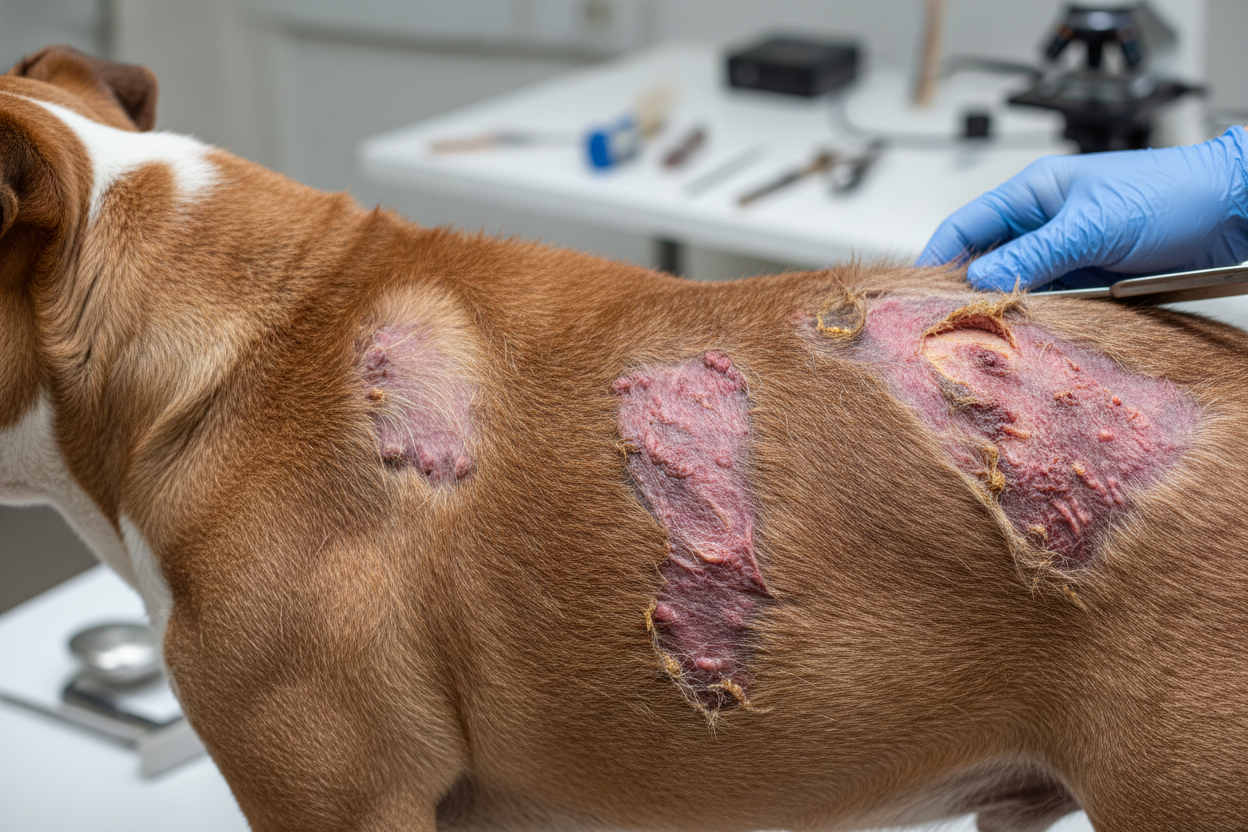
In dogs, FAD typically presents as intense pruritus (itching) concentrated at the base of the tail, the rump, the inner thighs, and the abdomen. The classic distribution is the "flea triangle" — the lower back, rump, and tail base. Dogs with FAD self-traumatise extensively — biting, chewing, and scratching — leading to alopecia (hair loss), excoriation, secondary bacterial pyoderma, and hot spots (acute moist dermatitis). In chronically affected dogs the skin becomes thickened, hyperpigmented, and lichenified. FAD is the most common cause of allergic skin disease in dogs in the UK.
FAD in Cats
In cats, FAD presents differently. The most characteristic manifestation is miliary dermatitis — a pattern of small, crusty papules distributed across the dorsal (back) surface of the body, particularly along the spine and around the neck. Cats may also develop eosinophilic granuloma complex lesions, indolent ulcers on the upper lip, or symmetrical alopecia of the ventral abdomen and inner thighs from excessive grooming. Because cats are meticulous groomers, they often remove fleas from their own coat before they can be detected — a flea-allergic cat may show severe skin lesions with very few or no fleas visible on examination, which frequently leads to misdiagnosis.
Why This Matters in Multi-Pet Households
In a home with both a dog and a cat, it is entirely possible — and common for the cat to be the primary flea host (carrying the larger proportion of the flea population) while the dog shows more severe clinical signs due to FAD, or vice versa. Treating only the symptomatic animal while ignoring the other animal and the environment will fail, because the untreated animal continues to maintain the environmental flea reservoir from which the treated, sensitised animal is re-exposed. All animals must be treated simultaneously.
Disease Risks From Flea Transmission Between Dogs and Cats
Beyond the direct dermatological effects, fleas can transmit several pathogens and parasites that are relevant to pet owners in the UK:
Dipylidium caninum (Tapeworm)
Dipylidium caninum is the flea tapeworm — its life cycle is dependent on fleas as an intermediate host. Larval tapeworm segments (cysticercoids) develop inside flea larvae that have ingested tapeworm eggs from contaminated faeces. When a cat or dog accidentally ingests an infected adult flea during grooming, the tapeworm develops to maturity in the intestine. Infected animals shed tapeworm proglottids (mobile, rice grain-like segments) in their faeces and around the perianal area. D. caninum can also, rarely, infect children who ingest an infected flea — most commonly reported in young children who have close contact with infested pets. Effective flea control eliminates the intermediate host and breaks the tapeworm life cycle. Animals with confirmed flea infestations should also be treated with a tapeworm-active wormer (praziquantel) at the same time as flea treatment.
Bartonella henselae (Cat Scratch Disease)
Bartonella henselae is primarily a feline pathogen transmitted between cats via the cat flea. Infected cats shed Bartonella-contaminated flea faeces (flea dirt) from their claws and fur; when a cat scratches a human, contaminated flea dirt is inoculated into the skin, causing cat scratch disease (CSD) — characterised by regional lymphadenopathy, low-grade fever, and malaise in immunocompetent individuals, and potentially severe systemic disease in immunocompromised people. Direct flea bites on humans can also transmit Bartonella, though this is a less common route. Dogs are not considered a significant reservoir for B. henselae. Effective flea control on cats significantly reduces human risk of CSD.
Haemobartonellosis (Feline Infectious Anaemia)
Mycoplasma haemofelis (previously classified as Haemobartonella felis) can be transmitted between cats via fleas. It causes destruction of red blood cells and potentially severe haemolytic anaemia in affected cats, particularly in cats that are immunocompromised or FIV-positive. This is a cat-specific pathogen and is not transmitted to dogs or humans via fleas.
Murine Typhus and Plague: A UK Context Note
Xenopsylla cheopis (the rat flea) is the primary vector of Rickettsia typhi (murine typhus) and Yersinia pestis (plague). Both are significant diseases globally but are not relevant to domestic pet flea management in the UK — X. cheopis is associated with rats and is not the species infesting domestic cats and dogs. It is mentioned here only to clarify that the disease risks relevant to UK pet owners are those above, not the historically significant diseases sometimes associated with "fleas" in general public awareness.
Treating a Multi-Pet Household Dogs and Cats Together
The single most common reason flea treatment fails in multi-pet households is that only one animal is treated. Since C. felis infests both dogs and cats with equal facility, an untreated animal immediately re-infests the treated one and re-seeds the environmental reservoir with eggs. The following principles apply:
- Treat all animals on the same day. Do not stagger treatment. All cats and all dogs in the household must receive flea treatment simultaneously.
- Use species-appropriate products. This is critical. Several effective dog flea treatments — including all products containing permethrin, and Vectra 3D — are acutely toxic to cats. Never apply a dog flea product to a cat, and keep permethrin-treated dogs away from cats until the product has dried completely. If you are unsure whether a product is safe for cats, check the VMD product information or ask your vet or pharmacist before applying.
- Treat the home environment on the same day. Applying a household spray (Indorex, Acclaim) to all carpets, soft furnishings, and floor crevices at the same time as treating the animals is essential. Treating the animals without treating the home eliminates the 5% of the flea population that is on the animals while leaving the 95% in the environment entirely undisturbed.
- Worm all animals for tapeworm. Any flea infestation should trigger concurrent tapeworm treatment with a praziquantel-containing product, because fleas and Dipylidium caninum co-occur reliably. Products covering both include Drontal (cats and dogs) and Milbemax.
- Allow time for the treatment to work. In a multi-pet household with an established infestation, some flea activity (bites) may continue for 4–8 weeks after correct treatment as dormant pupae in the environment continue to emerge. This is expected and does not mean the treatment has failed — declining bite frequency over time is the indicator of success.
Product Safety in Households With Both Cats and Dogs
| Product / Ingredient | Safe for Dogs | Safe for Cats | Key Risk If Misused |
|---|---|---|---|
| Permethrin (spot-on, e.g. Vectra 3D) | Yes | No — acutely toxic | Severe neurological toxicity in cats — can be fatal. Keep treated dogs away from cats until dry. |
| Fipronil (e.g. Frontline) | Yes | Yes (cat-labelled formulations only) | Do not use dog-labelled concentration on cats |
| Imidacloprid (e.g. Advocate, Advantage) | Yes | Yes (cat-labelled formulations only) | Safe for cats — use species-appropriate dose |
| Isoxazolines — oral (NexGard, Simparica, Bravecto oral, Credelio) | Yes — licensed for dogs | Not licensed in oral form for cats in UK | Do not give dog oral isoxazolines to cats |
| Fluralaner spot-on (Bravecto spot-on cats) | Separate dog formulation available | Yes — cat-specific formulation | Use species-specific formulation only |
| Indorex / Acclaim household spray | Safe in home after drying | Safe in home after drying | Keep all pets and people out of treated rooms until dry and ventilated per label |
Prevention in Homes With Both Cats and Dogs
Year-round flea prevention is more effective than treating active infestations, both clinically and economically. In multi-pet households the case for continuous prevention — rather than seasonal or reactive treatment — is particularly strong, because a single lapse in treatment on either animal can re-establish a full environmental infestation within weeks.
- Maintain continuous, year-round treatment on all animals. UK homes are warm enough year-round to support active flea populations — the traditional "flea season" framing underestimates the risk from autumn through spring in centrally heated properties.
- Choose products that suit both animals' lifestyles. A dog that swims regularly may lose efficacy from water-soluble spot-ons — an oral product may provide more consistent coverage. An indoor-only cat with no tick exposure may be adequately protected by a simpler product than an outdoor cat in a tick-endemic area.
- Vacuum frequently. Regular vacuuming of all carpeted areas, soft furnishings, and floor crevices mechanically removes eggs and larvae and stimulates dormant pupae to hatch into the treated environment — accelerating the exhaustion of the environmental reservoir.
- Wash pet bedding at 60°C regularly. Hot washing kills all life cycle stages.
- If either animal develops signs of FAD, review treatment with your vet. An animal with confirmed FAD may benefit from a faster-killing product (isoxazoline for the dog, Bravecto spot-on for the cat) to minimise allergen exposure per bite, rather than a standard-efficacy product.
References
- Rust, M. K., & Dryden, M. W. (1997). The biology, ecology, and management of the cat flea. Annual Review of Entomology, 42(1), 451–473. https://doi.org/10.1146/annurev.ento.42.1.451
- Beugnet, F., Franc, M., & Cadiergues, M. C. (2014). Comparative efficacy of flea control strategies in dogs. Parasite, 21, 56. https://doi.org/10.1051/parasite/2014056
- Mertins, J. W. (1991). Ectoparasites of the cat. In: Chandler, E. A. et al. (eds), Feline Medicine and Therapeutics. Blackwell Scientific Publications.
- Bitam, I., Dittmar, K., Parola, P., Whiting, M. F., & Raoult, D. (2010). Fleas and flea-borne diseases. International Journal of Infectious Diseases, 14(8), e667–e676. https://doi.org/10.1016/j.ijid.2009.11.411
- Durden, L. A., & Hinkle, N. C. (2019). Fleas (Siphonaptera). In: Mullen, G. R., & Durden, L. A. (eds), Medical and Veterinary Entomology, 3rd edition. Academic Press.
- Chomel, B. B., & Kasten, R. W. (2010). Bartonellosis, an increasingly recognized zoonosis. Journal of Applied Microbiology, 109(3), 743–750.
Disclaimer: This article has been written by a UK-registered pharmacist for general informational and educational purposes only. It does not constitute veterinary advice and is not a substitute for professional veterinary consultation, diagnosis, or treatment. Always seek the guidance of a qualified veterinary surgeon regarding any questions you may have about your pet's health, medication, or medical condition. Never disregard professional veterinary advice or delay seeking it because of something you have read in any article. The information provided reflects peer-reviewed literature and UK veterinary guidance available at the time of writing and is subject to change. FurBabies™ Botanicals and its founder accept no liability for any loss, injury, or damage arising from reliance on the content of this article. This article is intended for a UK audience only.







Share:
A-Z Guide Flea Treatment For Dogs & Cats
Does the choice of pet shampoo matter?