
Last updated: November 2026 |
Quick answer: Harvest mites are tiny orange larvae (about 0.2–0.3 mm) that climb onto dogs and cats from grass and undergrowth in late summer and autumn. They cluster between the toes, on legs, belly and ears, and can cause intense itching. No product is licensed in the UK specifically for harvest mites. Vets may use fipronil spray off-label, which controlled mites in 15 of 18 dogs in one study. Never use a permethrin dog spot-on on a cat: permethrin is toxic to cats.
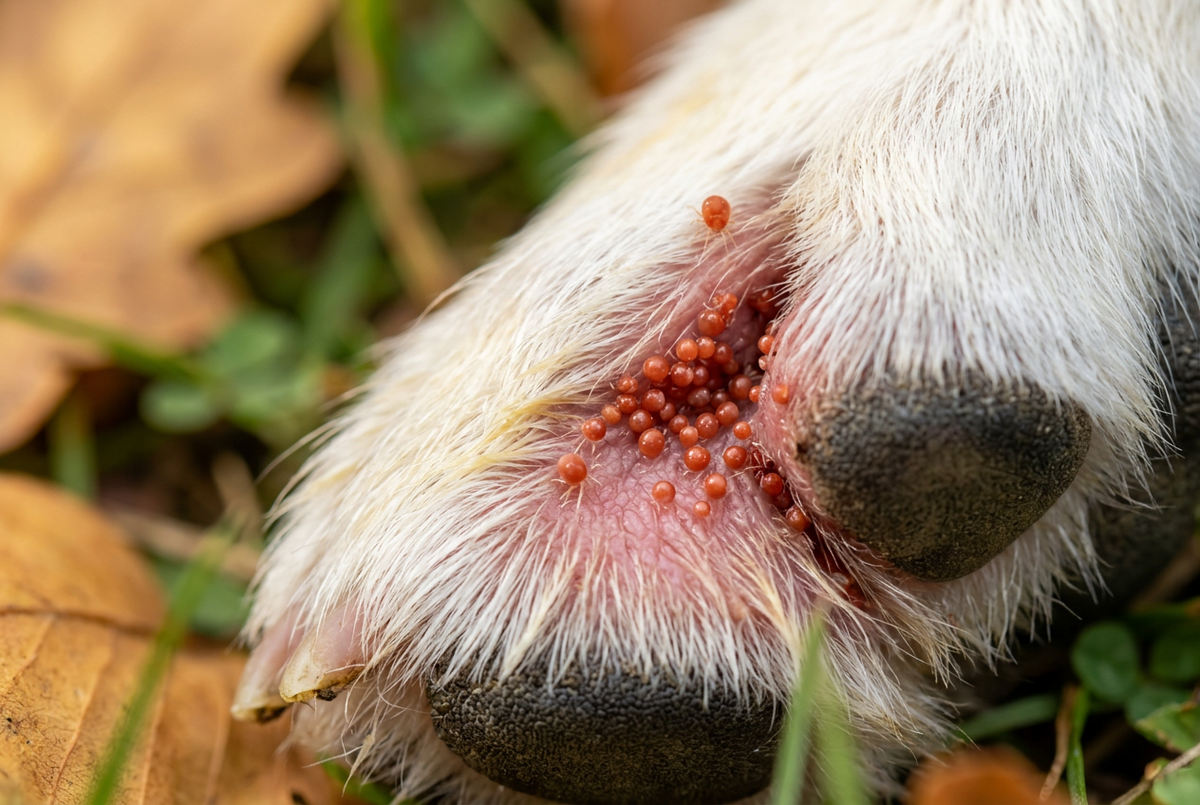
If you have found clusters of bright orange dots between your dog's toes, or your cat has started scratching at the edges of their ears, the culprit is very often the harvest mite (Neotrombicula autumnalis). Only the larvae bite, and they are not passed from pet to pet [1]. The PDSA describes them showing up from July to November [2], and field research found larvae active until the end of October or early November [3], so mites may still be about now.
What makes this guide different: as a pharmacist I've looked at the licensing, not just the treatments. You'll find out why "does Frontline kill harvest mites?" has a more complicated answer than most sites admit, what the prescribing cascade means for you, the cat safety warning that matters most, and a side-by-side table to help you work out whether it's mites at all.
Contents
- What are harvest mites?
- Signs in dogs: where to look
- Harvest mites in cats
- Is it harvest mites or something else?
- What kills harvest mites on dogs?
- Does Frontline kill harvest mites? The licensing nuance
- Reducing the risk on walks
- Practical FurBabies routine for sore-looking paws
- When to see a vet
- FAQs
- References
What are harvest mites?
Only the larval stage of this soil-dwelling mite feeds on animals. Larvae wait on grass and plants and latch on to passing dogs, cats and people [1].
- Size and colour: about 0.2–0.3 mm and bright orange [1]. Clusters can look like a dusting of paprika.
- Feeding: they feed for 5 to 7 days, then drop off [1]. The itch can carry on after they've gone.
- When: ESCCAP describes July to October, especially in dry, sunny weather [1]. Field research found larvae from mid-July right through to the end of October or early November [3].
- Where: the same patches of ground can stay infested for at least three years [3].
- Not contagious: your pets can't catch them from each other [1].
Harvest mites can bite people too. A case report described a woman and her dog both being bitten [4]. If you get itchy spots after autumn walks, mention the dog walks to your GP or pharmacist.
Signs in dogs: where to look
Mites tend to gather where the skin is thin and close to the ground. Check these areas after walks [1, 2]:
- Feet, especially between the toes
- Legs, armpits and belly
- Around the genitals
- Head and ears (occasionally)
Look for orange specks in clusters, red bumps, licking or chewing at the feet, and sudden scratching after a walk. Constant licking can leave skin red and sore, and open the door to infection.
Harvest mites in cats
Cats are often overlooked. A study of 72 cats with harvest mites concluded the problem is probably underestimated [5]:
- Ears were affected in 80.5% of cats [5]. Check the ear edges and the small pocket on the outer ear first.
- Only 43% were itchy [5], so the problem is easy to miss.
- Most cases were in autumn: 41 of the 72 [5].
Roaming cats are hard to keep mite-free: in one study, cats treated with fipronil spray were re-infested within 7 to 10 days [6].
If your cat is overgrooming or has scabby ears in autumn, see our guides to the best anti-itch options for cats and cat overgrooming, and ask your vet before using any parasite product.
Pharmacist's safety note: permethrin and cats
- Some dog spot-ons contain permethrin (Effitix-type products combine permethrin with fipronil). Permethrin is toxic to cats [7], so treat any exposure as an emergency.
- Never put a dog spot-on on a cat, even a tiny amount, and keep cats away from a freshly treated dog until the product has dried.
- If a cat has had contact with a permethrin product, phone your vet or an out-of-hours vet straight away. Don't wait for signs.
- Don't use essential oils, tea tree, or human anti-itch creams on cats without veterinary advice.
Is it harvest mites or something else?
Itchy paws in autumn are not always mites. The table below isn't drawn from a study. It's the clinical reasoning a vet or pharmacist works through with an itchy pet, so you can bring better notes to your appointment. Our free Dog Itch & Smell Checker walks you through the same questions.
| Clue | Harvest mites | Environmental allergy | Fleas | Contact irritation | Yeast |
|---|---|---|---|---|---|
| What you might see | Orange specks in clusters | Redness, no visible bugs | Black "flea dirt" that turns red on damp paper | Redness where skin touched something | Brown staining, greasy skin, musty smell |
| Typical areas | Between toes, legs, belly, ear pockets | Paws, face, ears, armpits, belly | Lower back and base of tail | Hairless contact areas: belly, chin, feet | Between toes, ears, skin folds |
| Timing | Late summer to autumn, after grassy walks | Often recurs each year, may be year-round | Any time, worse in warm homes | Soon after a new product, carpet or plant | Often follows another itchy problem |
| Other pets affected? | Only if they walk the same places | Usually just one | Often several | Any pet exposed | Usually just one |
| Read more | This article | Itchy skin guide | A–Z flea treatment | Contact dermatitis | Ask your vet for a skin test |
These problems can overlap, and constant licking can encourage yeast. If unsure, a vet can check the specks under a microscope.
What kills harvest mites on dogs?
The honest answer: there is very little research, and nothing licensed in the UK specifically for this mite. Here is what the evidence shows.
- Fipronil spray (e.g. Frontline Spray): in one study, monthly spraying controlled harvest mites in 15 of 18 dogs, and 2 more were controlled when their feet were also sprayed every fortnight [6].
- Permethrin plus fipronil spot-on (Effitix): used off-label in a small study of 10 dogs, 9 were mite-free at days 14 and 28, and itching fell by 82% by day 14 [7]. Dogs only, because permethrin is toxic to cats.
- Isoxazoline chews (the monthly or three-monthly flea and tick tablets): we found no published evidence either way for harvest mites. See our guide to the strongest flea treatments for what they are licensed for.
- Itch control: because the itch can outlast the mites, your vet may suggest a short course of anti-itch medicine. Medicines such as Apoquel (oclacitinib) and the Cytopoint injection are licensed for allergic itch, so whether they suit your dog is a vet decision.
We found no published evidence that home remedies such as vinegar, coconut oil or essential oils work against harvest mites. For safe general itch measures, see what you can do for your dog's itching.
Does Frontline kill harvest mites? The licensing nuance
This is the part other guides skip. Every UK veterinary medicine has a Summary of Product Characteristics (SPC) from the Veterinary Medicines Directorate, listing exactly what it is licensed to treat.
Frontline Spray 0.25% is licensed for fleas, ticks, lice and flea allergy dermatitis. Harvest mites (N. autumnalis) are mentioned only in the section describing how the drug works (pharmacodynamics). They are not listed as a licensed indication [8]. Frontline Spray's UK product information mentions harvest mites in its pharmacodynamic section, but harvest mites are not included in its licensed treatment indications. A vet may therefore prescribe it off-label for harvest mite infestation. The vet should explain the reason for using it and the dosing instructions, which may differ from the product's standard directions.
So when your vet uses Frontline Spray for harvest mites, they are using it "off-label" under what's called the prescribing cascade. In simple terms:
- If there's a medicine licensed for that condition in that species, the vet should use it first.
- If there isn't one (as with harvest mites), the vet may use a medicine licensed for something else, or for another species.
- The vet takes clinical responsibility for that choice and should explain it to you and ask for your consent.
Off-label doesn't automatically mean unsafe. It means the product isn't licensed for that use, so the evidence and the responsibility sit with your vet's judgement. Follow your vet's dosing exactly, as it may differ from the pack (for example, extra spraying of the feet [6]).
Reducing the risk on walks
ESCCAP advises avoiding areas you know are infested during the season [1]. The tips below are common sense rather than research-proven, but they are low-risk:
- Note your hotspots. Because infested patches can persist for years [3], keep a mental map and walk elsewhere from late summer to early November.
- Stick to paths and short grass rather than long grass, field margins and undergrowth, especially on warm, dry days.
- Check and wipe paws after walks. Look between the toes in good light.
- Keep long foot fur trimmed so you can see the skin between the toes.
- Ask your vet about preventive spraying before the season if your dog suffers every year.
Practical FurBabies routine for sore-looking paws
To be clear: none of our products kill or repel harvest mites, and they are not a treatment. Mites need a vet-recommended product. Afterwards, some dogs are left with dry, rough-looking pads. A gentle grooming routine can help:
- Wash: Gentle Rinse-Off Shampoo cleanses muddy feet and coat without harsh sulfates. Ask your vet how long to wait after a spot-on or spray before bathing.
- Condition: Paw, Nose & Wrinkle Balm, with avocado, essential fatty acids and ceramides, moisturises dry pads. Use a thin layer on unbroken skin only. Don't apply to raw, weeping or infected areas; those need a vet.
When to see a vet
Book a vet appointment if:
- The itching is intense, or your pet is chewing their feet raw
- The skin is broken, weeping, smelly or swollen
- Itching continues more than a few days after the specks have gone
- Your cat has scabby ears or is overgrooming
- You aren't sure what you're looking at
Our guide on dog itchy skin causes and relief covers other reasons to get checked.
When to worry: rare neurological cases
Very rarely, dogs exposed to trombiculid mites have developed nervous system signs. A dog in Spain was reported with neurological signs linked to a related trombiculid mite, Neotrombicula inopinata [9]. In the Netherlands in August 2024, four dogs developed neurological signs after mite exposure; three recovered and one was put to sleep [10]. These are case reports, not proof that harvest mites cause this, and the vast majority of dogs only get itchy.
See a vet urgently if your dog becomes wobbly, weak, has tremors, a head tilt, collapses or has a seizure, or vomits repeatedly and seems very flat after autumn woodland walks.
What about seasonal canine illness (SCI)? Harvest mites have long been suggested as a possible trigger for SCI, the sudden autumn illness seen after woodland walks. That link has never been proven. Read our sibling guide to seasonal canine illness in the UK for the signs and what the research does and doesn't show.
FAQs
What are the orange dots between my dog's toes?
Clusters of tiny bright orange dots between the toes in late summer or autumn are most likely harvest mite larvae. They are about 0.2 to 0.3 mm long, feed for around 5 to 7 days and then drop off. They often cause intense itching. Ask your vet to confirm, as they can check under a microscope quickly.
What kills harvest mites on dogs?
No UK product is licensed specifically for harvest mites. Vets may use fipronil spray off-label: in one study, monthly spraying controlled mites in 15 of 18 dogs, with extra foot spraying helping two more. A permethrin and fipronil spot-on also worked in a small study, but must never be used on cats.
Does Frontline kill harvest mites?
Frontline Spray can help, and vets use it for harvest mites, but it is not licensed for them in the UK. Its official product information lists harvest mites only when describing how the drug works, not as an approved use. Vets prescribe it off-label under the prescribing cascade, so follow their dosing exactly.
Can cats get harvest mites in their ears?
Yes. In a study of 72 cats with harvest mites, the ears were affected in 80.5% of cases. Only 43% of the cats were itchy, so many owners never notice. Check the ear edges and the small skin pocket on the outer ear in autumn, and ask your vet before using any parasite product on a cat.
When is harvest mite season in the UK?
Harvest mites are mainly active from July to October, especially in dry, sunny weather, but research found larvae until the end of October or early November. The same patches of ground can stay infested for at least three years, so avoid known hotspots during the season.
Are harvest mites contagious between pets or to people?
They don't spread from pet to pet. Each animal picks them up directly from grass and vegetation, so two affected pets have usually walked the same ground. People can be bitten too, though: a case report described a woman and her dog both bitten by harvest mites.
Do flea and tick chews like NexGard or Bravecto work on harvest mites?
We don't know. We found no published evidence either way on isoxazoline chews for harvest mites, and they are not licensed for this use. They may or may not help. If your dog is badly affected every autumn, ask your vet which option they recommend for your dog.
Can I use my dog's spot-on on my cat?
No. Some dog spot-ons contain permethrin, which is toxic to cats and can cause serious poisoning. Never apply a dog product to a cat, and keep cats away from a freshly treated dog until it has dried. If your cat has been exposed, contact a vet immediately.
Related articles
- Dog Itchy Skin: Causes, Relief and Treatment
- What Can I Do for My Dog's Itching?
- A–Z of Flea Treatment
- The Strongest Flea Treatments
- Apoquel (Oclacitinib) for Dogs
- Cytopoint Injection for Dogs
- Best Anti-Itch for Cats
- Seasonal Canine Illness (SCI) in the UK
- Conkers, Acorns and Mushrooms: Autumn Poisons for Dogs
- Free Dog Itch & Smell Checker (PDF)
References
- ESCCAP (2022) Guideline 03: Control of Ectoparasites in Dogs and Cats, 7th edition. esccap.org
- PDSA (2020) Harvest mites in dogs. PDSA Pet Health Hub. pdsa.org.uk
- Schöler A, Maier WA, Kampen H (2006) Experimental and Applied Acarology 39(1): 41–62.
- Guarneri C et al. (2017) IDCases 9: 4–5. doi:10.1016/j.idcr.2017.04.003
- Leone F et al. (2013) Veterinary Dermatology 24(5): 535–537. doi:10.1111/vde.12053
- Nuttall TJ, French AT, Cheetham HC, Proctor FJ (1998) Journal of Small Animal Practice 39(5): 237–239. doi:10.1111/j.1748-5827.1998.tb03641.x
- Lecru L-A et al. (2019) Veterinary Sciences 6(4): 100. doi:10.3390/vetsci6040100
- Veterinary Medicines Directorate. Summary of Product Characteristics: Frontline Spray 0.25%. vmd.defra.gov.uk
- Santibáñez P et al. (2020) Emerging Infectious Diseases 26(4): 819–820. doi:10.3201/eid2604.191313
- Santifort KM, Reijmerink HA (2025) Emerging Infectious Diseases 31(12). doi:10.3201/eid3112.241758
Disclaimer: This article is for educational purposes only and does not replace veterinary advice, diagnosis or treatment. If your pet is distressed, injured or unwell, contact your veterinary surgeon or an out-of-hours vet.






Share:
Are Conkers, Acorns and Mushrooms Poisonous to Dogs? A Pharmacist's UK Guide to Autumn Poisons (2026)