

Last updated: November 2026
Quick answer: The approaches with the best evidence for firework fear are vet-prescribed medicine (two placebo-controlled trials on New Year's Eve) and longer-term sound desensitisation and counter-conditioning, which owners rate as the most successful option. Pressure wraps such as ThunderShirts are low-risk and help some dogs, but a 2024 systematic review found the evidence is weak. Pheromone plug-ins, herbal calmers and essential oils perform at roughly placebo level in owner surveys. Comforting your dog does not make the fear worse. If your dog panics, hides for hours or tries to escape, call your vet now rather than on the night.
Around 4 in 10 UK dogs are frightened of fireworks. PDSA's 2024 Animal Wellbeing (PAW) Report puts it at 41% of dogs and 30% of cats [1]. Fireworks season now stretches from Diwali through Bonfire Night to New Year's Eve, so this is weeks of disruption, not one night.
Most guides give you a list of tips. This one does something different: it grades each option by the quality of evidence behind it, so you can spend your time and money on what is most likely to help. As a pharmacist I've also included the medicine safety points other guides leave out.
Contents
- Is my dog scared? The signs owners miss
- The firework fear evidence scorecard
- Do pressure wraps and ThunderShirts work?
- Vet medicines: what the trials show
- The 72-hour countdown plan
- On the night: hour-by-hour
- Cats and small pets
- After the bangs: recovery and prevention
- UK fireworks times and the law
- FAQs
- References
Is my dog scared? The signs owners miss
Many owners underestimate their dog's fear. In a University of Bristol study, about a quarter of owners described their dog as "fearful" of noises in a postal survey. When a subset were interviewed in detail, almost half reported at least one behavioural sign of fear [2]. Trembling and hiding are easy to spot. Quieter signs are not.
Watch for:
- Panting when it isn't warm (see Why Is My Dog Panting So Much?)
- Pacing, unable to settle, or following you from room to room
- Lip licking, yawning, ears pinned back, tail tucked
- Hiding under furniture or behind the toilet
- Refusing food or treats they would normally take
- Barking, whining or howling
- Toileting indoors or destructive chewing near doors
- Trying to escape
Fear also tends to start young and can grow. In a survey of 1,225 owners, most dogs developed firework fear in their first year of life, and new cases after age 7 were rare [3]. In the Bristol study, risk of noise fear rose with age [2]. Older dogs with joint pain deserve a closer look: if your senior dog has become more noise-sensitive, mention it to your vet alongside any stiffness.
The firework fear evidence scorecard
This table pulls together the best available evidence for each option. "Owner success rate" comes from a 2020 study of 1,225 owners who rated how well each treatment had worked for their dog [4]. It is owner opinion, not a controlled trial, so read it alongside the "best evidence" column.
| Option | Owner success rate [4] | Best evidence | Our verdict |
|---|---|---|---|
| Counter-conditioning (bangs = good things) | Over 70% | Owner survey; desensitisation programmes described as having an excellent prognosis [5] | Strong. Best long-term fix. |
| Relaxation training | 69% | Owner survey | Good. Worth starting now. |
| Prescription medicine | 69% | Two randomised, placebo-controlled New Year's Eve trials [6, 7] | Strong. Talk to your vet this week. |
| Noise CDs / sound apps | 55% | Owner survey; works best as part of a structured programme | Moderate. Needs weeks, not days. |
| Pressure wrap / ThunderShirt | 44% | Systematic review of 4 small studies: weak, limited evidence [8] | Low-risk add-on. Helps some dogs. |
| Pheromone diffusers | 27–35% (grouped with herbal and other remedies) | One small open trial without a placebo group [9] | Weak. Don't rely on it alone. |
| Herbal calmers, nutraceuticals, essential oils, homeopathy, Bach flowers | 27–35% | The study's author judged these no better than placebo [4] | Not recommended as treatment. |
One honest caveat: a 27–35% "success" rate does not mean nothing happens. Firework nights vary, and owners naturally notice improvement. That is exactly why placebo-controlled trials matter, and why we've weighted them more heavily than owner opinion.
Do pressure wraps and ThunderShirts work?
A pressure wrap is a snug vest that applies gentle, even pressure around the chest and body, a bit like swaddling. ThunderShirt is the best-known brand and they are popular because they are drug-free and easy to use, so it is worth looking honestly at what the research shows.
What the studies found
- The only study using firework sounds (28 noise-phobic dogs, double-blind) found no clear therapeutic effect and no change in stress hormones. But dogs wearing the vest froze less and sought out their owners more, and 16 of 20 owners who used it on New Year's Eve reported a positive effect. The vest manufacturer funded the study [10].
- A trial of 90 anxious dogs found heart rate fell in dogs wearing a snug ThunderShirt, while it rose in the control group. A loosely fitted vest worked less well than a snug one. Observers were not blinded [11].
- An open trial in dogs with thunderstorm phobia found 17 of 19 owners rated the wrap effective, but there was no control group and the manufacturer funded the work, make of that what you will [12].
- A 2024 systematic review combined these and one other study and concluded there is "weak and limited evidence" for a benefit, with generally poor blinding [8].
- Owner ratings: 44% of 300 owners who had tried a pressure vest felt it worked [4].
- TTouch body wraps (elasticated bandage wraps): we could find no published studies at all.
How to give a wrap its best chance
If you'd like to try one, how you use it matters as much as which one you buy. A veterinary evidence review advises getting the dog used to the vest and checking comfort rather than putting it on for the first time mid-panic [13].
- Introduce it on a calm day (you can trial a shawl or a long scarf) Put it on for a few minutes alongside treats or dinner, then take it off. Build up over several days so the wrap predicts good things, not bangs.
- Fit it snugly. In the 90-dog trial, the snug fit outperformed a loose one [11]. You should still be able to slide two fingers under it, and your dog must be able to breathe, move and lie down normally.
- Put it on before the bangs start, not after your dog is already shaking.
- Supervise. Take it off if your dog seems distressed by it, overheats or starts chewing it. Don't leave it on all night unattended and make sure it is not too tight or can snag on items at your companion's level.
- Use it alongside your plan, not instead of it. Think of a wrap as one layer, like a den or background noise.
Bottom line: a pressure wrap is cheap, safe for most dogs and helps some of them. It is very unlikely to be enough for a dog with severe panic. Those dogs need a vet.
Vet medicines: what the trials show
For moderate to severe fear, prescription medicine has the strongest evidence of anything available. Two licensed options have been tested in randomised, double-blind, placebo-controlled trials on New Year's Eve:
- Dexmedetomidine oromucosal gel (Sileo): In 182 dogs, 72% given the gel had a good or excellent response, compared with 37% given placebo. It did not cause significant sedation [6].
- Imepitoin (Pexion): In 238 dogs, imepitoin started two days before New Year's Eve significantly reduced fear scores compared with placebo [7]. The timing point matters: it needs to be started in advance, which is why you should book a vet appointment now.
Your vet may suggest other options depending on your dog's health and other medicines.
Pharmacist's safety note
- Never give your dog human diazepam, sleeping tablets or a family member's prescription. Doses, effects and interactions differ in dogs, and some drugs can make fear behaviour worse.
- Antihistamines such as Piriton are not a firework treatment. See Piriton for Dogs for what they are and aren't used for.
- Tell your vet about every product your dog takes, including supplements and calming chews, so they can check for interactions.
- Ask your vet for a trial dose on a quiet evening so you know how your dog responds before the big night.
The 72-hour countdown plan
If fireworks are a few days away and you haven't prepared, this is what to prioritise.
3 days before
- Phone your vet if your dog has shown panic, escape attempts or self-injury in past years. Some medicines need starting in advance [7].
- Check microchip details are up to date. The Kennel Club reports an 81% rise in missing dogs during fireworks season, and more than 1 in 10 owners say their dog has tried to flee [14].
- Find out when local displays are on (councils, schools, sports clubs, social media groups).
- Start introducing a pressure wrap if you plan to use one.
2 days before
- Build a den where your dog already likes to hide. Cover a crate or table with heavy blankets, leaving the door open. Add bedding that smells of you.
- Practise closing curtains and playing the TV or music at a normal level in the evening, so it isn't a sudden change on the night.
- Check fences, gates and garden escape routes.
The day
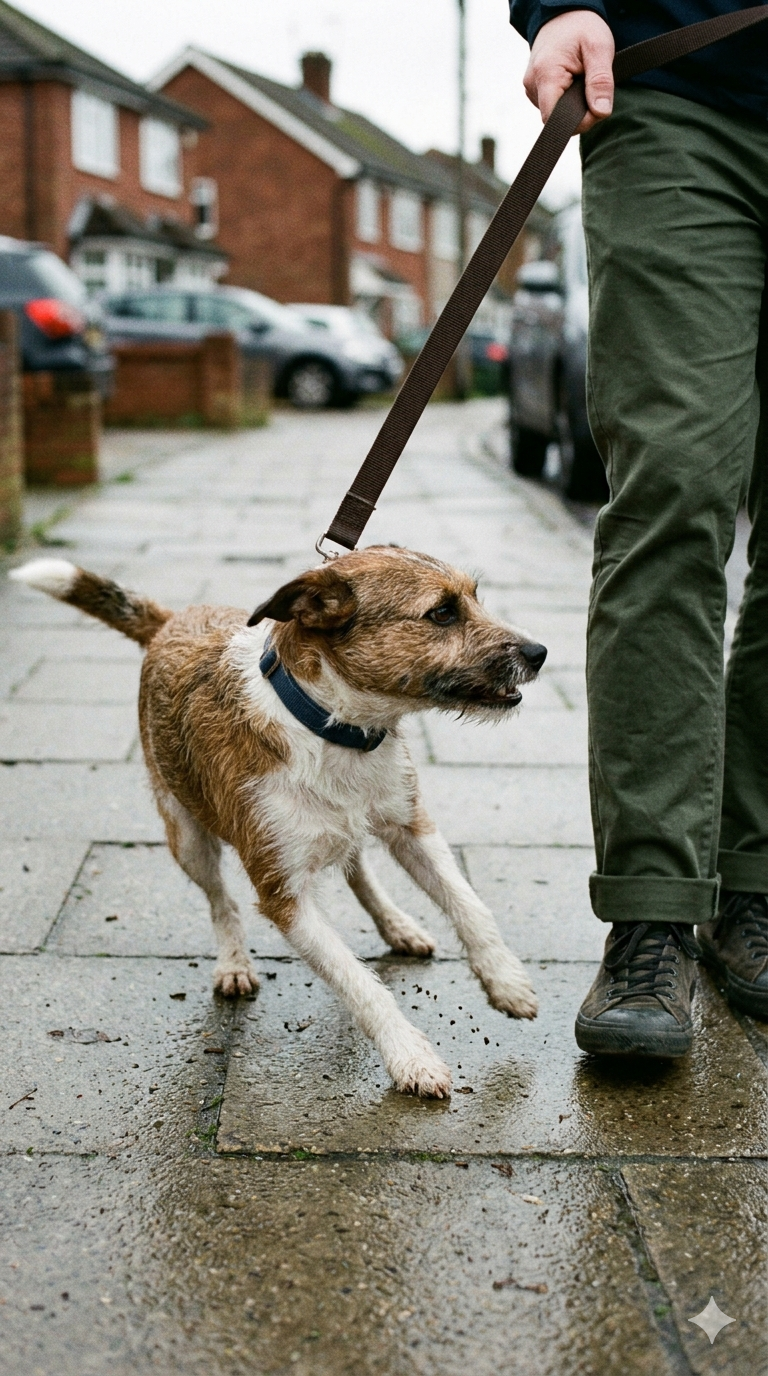
- Walk your dog well before dusk. Use a well-fitted harness, and a second lead clipped to the collar if your dog is a known bolter. Our guide to collars vs harnesses explains why a panicking dog pulling on a collar can injure their neck.
- Feed dinner a little earlier, before the bangs start.
- Let them toilet in the garden on a lead before it gets dark.
- Give any vet-prescribed medicine exactly as directed.
On the night: hour-by-hour
- Before dark: Close windows, curtains and cat flaps. Lock doors and keep a gate or closed door between your dog and the front door when visitors arrive.
- As displays begin: Turn on TV, music or white noise to mask the bangs. Put the wrap on if you're using one.
- If your dog comes to you, comfort them. Calm stroking and a quiet voice do not reinforce fear. In the large owner study, petting or talking to the dog during fireworks was not associated with the fear getting worse [18], and Tufts veterinary school advises the same [15].
- If your dog hides, let them. Don't drag them out. A den they choose is better than a spot you choose.
- Stay calm and stay home if you possibly can. Your dog takes cues from you.
- Offer a long-lasting chew or lick mat if your dog will take food. Licking and chewing are self-soothing. A dog that refuses food is telling you they're very stressed.
- Don't punish accidents, barking or chewing. Your dog is frightened, not naughty.
Cats and small pets
PDSA's latest data suggest 30% of cats are afraid of fireworks [1], yet cats get far less attention. A New Zealand study of more than 3,500 dogs and cats found 46% of animals showed fear of fireworks, and 6% were injured as a result. Dog owners reported fear more often than cat owners, but the fear lasted just as long in both species [16].
- Keep cats in from before dusk and lock the cat flap.
- Give them high hiding places such as the top of a wardrobe or a box on a shelf. Cats often feel safer up high.
- Put a litter tray indoors, even if your cat normally goes outside.
- Don't try to coax a hiding cat out. Let them come out when they're ready.
- Rabbits and guinea pigs in outdoor hutches: bring them indoors or into a garage or shed if possible, or cover most of the hutch with a thick blanket while leaving ventilation. Add extra bedding so they can burrow.
Never use a dog-only calming or parasite product on a cat without checking with your vet or vet pharmacist. Some ingredients that are safe for dogs are toxic to cats.
After the bangs: recovery and prevention
Most dogs bounce back quickly, but not all. In the 1,225-owner study, almost three quarters of affected dogs recovered by the next morning. About 10% took up to a day, 12% took up to a week, and over 3% took several weeks or months [3].
- If your dog is still anxious after a week, or now reacts to other noises like car doors or thunder, speak to your vet. Fear of one loud noise often spreads to others [2].
- Write down what happened: the signs, how long they lasted, and what helped. This is gold for your vet when planning next year.
- Start sound desensitisation in spring or summer, not October. Play recorded firework sounds at a level so quiet your dog barely notices, pair them with food or play, and raise the volume very gradually over weeks. Stop and drop back if your dog shows any fear. Ask your vet to refer you to a qualified clinical animal behaviourist for a structured plan.
- Puppies: because most firework fear starts in the first year [3], gently pairing distant bangs with good things in a puppy's first fireworks season is one of the best investments you can make.
Fewer than a third of owners in the Bristol study sought professional help for their dog's fear [2]. Treatment works, so please ask.
UK fireworks times and the law
In England and Wales, fireworks must not be set off between 11pm and 7am, except [17]:
- Bonfire Night (5 November): until midnight
- New Year's Eve, Diwali and Chinese New Year: until 1am
Fireworks can only be sold by registered sellers from 15 October to 10 November, 26 to 31 December, and for 3 days before Diwali and Chinese New Year [17]. In practice, that is why the noise often runs for weeks. Scotland has its own rules.
If your pet is injured during fireworks, check your insurance policy. Our UK pet insurance comparison and guide to understanding vet costs may help.
FAQs
How do I calm my dog during fireworks tonight?
Walk them before dark, close curtains and windows, play TV or music to mask the noise, and let them hide in a den they choose. Comfort them calmly if they come to you. If your dog panics, tries to escape or hurts themselves, phone your vet or an out-of-hours vet.
Do ThunderShirts work for fireworks?
They help some dogs. In a study of 1,225 owners, 44% who used a pressure vest felt it worked, but a 2024 systematic review found the scientific evidence weak and limited. A ThunderShirt is a low-risk extra layer, best introduced on calm days first, but it is not enough on its own for a dog with severe fear.
Should I comfort my dog when fireworks are going off?
Yes. Calmly comforting a frightened dog does not reinforce fear. Research on firework-fearful dogs found petting or talking to the dog was not associated with the fear getting worse.
What can I give my dog for firework anxiety in the UK?
Only give medicine your vet has prescribed. Licensed options such as dexmedetomidine gel and imepitoin have been shown to reduce firework fear in placebo-controlled trials. Never give human sedatives, sleeping tablets or antihistamines without veterinary advice.
Do Adaptil plug-ins or calming treats work for fireworks?
The evidence is weak. In a large owner survey, pheromones, herbal products and other non-prescription remedies had success ratings of 27 to 35%, which the researcher judged no better than placebo. They are unlikely to cause harm but should not replace a proper plan or a vet visit.
How long does firework fear last after Bonfire Night?
Most dogs recover by the next morning. In one study, 12% took up to a week and over 3% took several weeks or months. If your dog is still anxious after a week, see your vet.
What time do fireworks have to stop in the UK?
In England and Wales, 11pm on most nights, midnight on Bonfire Night, and 1am on New Year's Eve, Diwali and Chinese New Year.
Are cats scared of fireworks too?
Yes. PDSA's 2024 data suggest 30% of UK cats are afraid of fireworks. Keep cats indoors from before dusk, lock the cat flap, provide a litter tray and high hiding places, and let them hide undisturbed.
Related articles
- Why Is My Dog Panting So Much? A Pharmacist's Complete Guide
- Dog Collar vs Harness: The Neck Damage Most Owners Don't Know About
- Conkers, Acorns and Mushrooms: Autumn Poisons for Dogs
- Does Cold Weather Make Dogs' Joints Stiffer?
- Piriton for Dogs: Doses, Side Effects and Risks
- Best Pet Insurance UK 2026
References
- PDSA (2024) PAW Report fireworks findings, reported in: PDSA issues warning ahead of New Year's fireworks. VN Online, 30 December 2024. vnonline.co.uk. See also PDSA, Dogs and fireworks.
- Blackwell EJ, Bradshaw JWS, Casey RA (2013) Fear responses to noises in domestic dogs: prevalence, risk factors and co-occurrence with other fear related behaviour. Applied Animal Behaviour Science 145. Summary: University of Bristol.
- Riemer S (2019) Not a one-way road: severity, progression and prevention of firework fears in dogs. PLoS ONE 14(9): e0218150. doi:10.1371/journal.pone.0218150
- Riemer S (2020) Effectiveness of treatments for firework fears in dogs. Journal of Veterinary Behavior 37: 61–70. doi:10.1016/j.jveb.2020.04.005
- McPeake K, Affenzeller N, Mills D (2017) Noise sensitivities in dogs: a new licensed treatment option. Veterinary Record 180(14): 353–355. doi:10.1136/vr.j1644
- Korpivaara M, Laapas K, Huhtinen M, Schöning B, Overall K (2017) Dexmedetomidine oromucosal gel for noise-associated acute anxiety and fear in dogs: a randomised, double-blind, placebo-controlled clinical study. Veterinary Record 180(14): 356–362. doi:10.1136/vr.104045
- Engel O, Müller HW, Klee R, Francke B, Mills DS (2019) Effectiveness of imepitoin for the control of anxiety and fear associated with noise phobia in dogs. Journal of Veterinary Internal Medicine 33(6): 2675–2684. doi:10.1111/jvim.15608
- Mathis S, Schoolfield S, Gross P, Gruen M, Dorman DC (2024) A systematic review of the efficacy of compression wraps as an anxiolytic in domesticated dogs. Animals 14(23): 3445. doi:10.3390/ani14233445
- Sheppard G, Mills DS (2003) Evaluation of dog-appeasing pheromone as a potential treatment for dogs fearful of fireworks. Veterinary Record 152(14): 432–436. doi:10.1136/vr.152.14.432
- Pekkin A-M, Hänninen L, Tiira K, et al. (2016) The effect of a pressure vest on the behaviour, salivary cortisol and urine oxytocin of noise phobic dogs in a controlled test. Applied Animal Behaviour Science 185: 86–94. doi:10.1016/j.applanim.2016.09.003
- King C, Buffington L, Smith TJ, Grandin T (2014) The effect of a pressure wrap (ThunderShirt) on heart rate and behavior in canines diagnosed with anxiety disorder. Journal of Veterinary Behavior 9: 215–221. doi:10.1016/j.jveb.2014.06.007
- Cottam N, Dodman NH, Ha JC (2013) The effectiveness of the Anxiety Wrap in the treatment of canine thunderstorm phobia: an open-label trial. Journal of Veterinary Behavior 8: 154–161. doi:10.1016/j.jveb.2012.09.001
- Buckley LA (2018) Are pressure vests beneficial at reducing stress in anxious and fearful dogs? Veterinary Evidence 3(1). doi:10.18849/ve.v3i1.152
- The Kennel Club (2024) Fireworks season sees 81% increase in dogs going missing, reported in VN Online. vnonline.co.uk
- Tufts Cummings School of Veterinary Medicine (2020) Fireworks, fireworks, fireworks. vet.tufts.edu
- Dale AR, Walker JK, Farnworth MJ, Morrissey SV, Waran NK (2010) A survey of owners' perceptions of fear of fireworks in a sample of dogs and cats in New Zealand. New Zealand Veterinary Journal 58(6): 286–291. doi:10.1080/00480169.2010.69403
- GOV.UK. Fireworks: the law. gov.uk/fireworks-the-law
- Riemer S (2019) Effectiveness of treatments for firework fears in dogs (preprint data on owner–dog interaction during fireworks). bioRxiv 663294. biorxiv.org/content/10.1101/663294v2
Disclaimer: This article is for educational purposes only and does not replace veterinary advice, diagnosis or treatment. If your pet is distressed, injured or unwell, contact your veterinary surgeon or an out-of-hours vet.

Share:
Dog Itchy Skin: Causes, Relief and What Actually Helps
Are Conkers, Acorns and Mushrooms Poisonous to Dogs? A Pharmacist's UK Guide to Autumn Poisons (2026)