
Last updated: November 2026
Quick answer: Yes, conkers (horse chestnuts) and acorns can both make dogs ill, usually with vomiting, diarrhoea and tummy pain, and both can cause a dangerous gut blockage. Most UK wild mushrooms are not toxic, but a few can be fatal, and as a rule, the later signs start, the more toxic the mushroom is likely to be. If your dog has eaten any of these, do not make them sick at home. Phone your vet or the Animal PoisonLine (01202 509000) straight away and keep a sample.
Autumn walks are full of things dogs want to eat: conkers, acorns, mushrooms and mouldy leftovers in compost heaps. In UK human data, enquiries to the National Poisons Information Service about mushrooms peak in October [1].
This guide goes beyond the usual list of "don'ts": a timeline of when signs appear (the delayed ones are the dangerous ones), poisoning vs blockage, real Veterinary Poisons Information Service figures, and a pharmacist's explanation of why you should never make your dog sick at home.
Contents
- Are conkers poisonous to dogs?
- My dog ate an acorn: how worried should I be?
- My dog ate a mushroom: what now?
- Poisoning vs blockage: two different risks
- Delayed signs are the dangerous ones: the timeline
- What the poisons service numbers show
- What to do in the next 10 minutes
- Why NOT to make your dog sick at home
- Cats and antifreeze
- Safer autumn walks
- When to see a vet
- FAQs
- References
Are conkers poisonous to dogs?
Yes. Conkers are the seeds of the horse chestnut tree (Aesculus). They contain esculin and escin, a soap-like compound called a saponin. In severe cases these can cause wobbliness, twitching and even seizures [2].
Severe cases are uncommon. When the Veterinary Poisons Information Service (VPIS) reviewed its cases, around a third of dogs that ate conkers showed no signs at all. When dogs did become ill, it was mostly stomach and gut upset, with vomiting the most common sign. The outcome was generally good, but more guarded if the conker caused a blockage [3].
A conker is hard, round and the right size to get stuck in a dog's gut, so even a dog that seems fine still needs watching.
My dog ate an acorn: how worried should I be?
Acorns, and oak leaves, contain tannins. In the body these are broken down into compounds (gallic acid and then pyrogallol) that can irritate the gut. Kidney and liver effects are possible in dogs, but sometimes the only problem is a blockage [4].
In the VPIS case review, around a quarter of dogs that ate acorns had no signs. The others mostly had [3]:
- Vomiting and diarrhoea, which may contain blood
- A tender tummy
- Going off their food
- Lethargy
- Occasionally hives or swelling of the lips and around the eyes
A dog that hoovers up mouthfuls under an oak is at more risk than one that eats a single acorn. Phone your vet either way, especially for small dogs and puppies.
My dog ate a mushroom: what now?
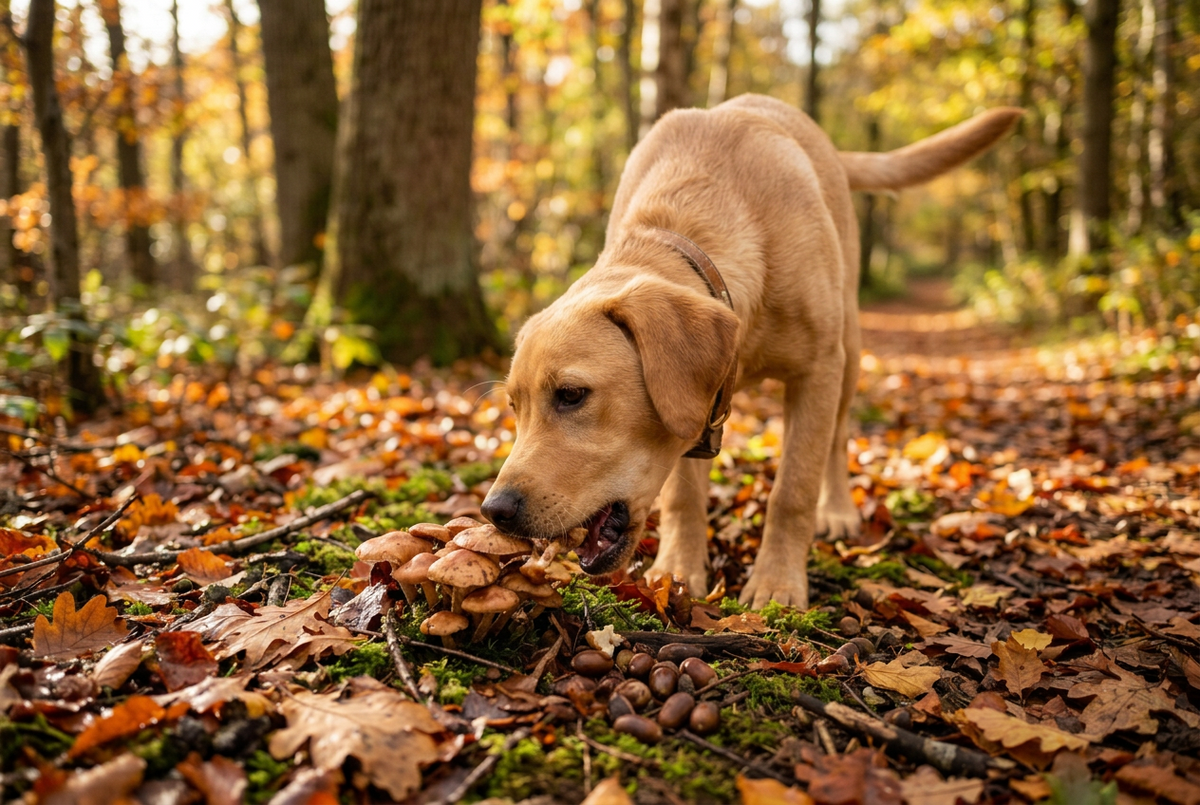
The UK has more than 4,000 species of fungi and most are not toxic, but you cannot reliably tell them apart in a park, so treat every mushroom as potentially dangerous [5].
VPIS advice includes a useful rule of thumb: Some mushroom toxins cause signs within minutes or hours. Others, including the toxins in death cap mushrooms, may not cause illness for 6–12 hours or longer. A dog that seems well after eating a mushroom can still be at risk.
The timing of symptoms can help vets assess the likely toxin, but it cannot reliably tell you how poisonous a mushroom is. Do not wait for symptoms or use a six-hour observation period to decide whether to seek help. Contact your vet immediately if your dog may have eaten a wild mushroom [5].
Turned around, that rule means late signs are a warning sign. A 2025 case report described a 12-week-old Shetland sheepdog puppy in the US that ate a mushroom containing alpha-amanitin, the toxin found in the death cap. The puppy suffered a cardiac arrest within 22 hours of arriving at the vet [6]. It is a single case, but it shows why "they seem fine" is not enough.
Mouldy food in compost heaps and bins can carry tremorgenic mycotoxins (mould toxins that cause tremors). Signs typically start within 1 to 2 hours and include tremors, overheating and seizures [7]. This is an emergency.
A note on evidence: the October peak comes from a 2025 study of 1,285 mushroom enquiries to the UK human poisons service (2013–2022), 305 of them in October [1]. It is human data, so it shows when mushrooms are being eaten, not how often dogs are poisoned.
Poisoning vs blockage: two different risks
Conkers and acorns carry two separate risks. VPIS flagged both [3], and with acorns the blockage may be the only problem [4].
| Poisoning | Blockage | |
|---|---|---|
| What causes it | Chemicals in the seed (saponins in conkers, tannins in acorns) [2, 4] | The physical object getting stuck in the stomach or intestine |
| Typical signs | Vomiting, diarrhoea (possibly bloody), tummy tenderness, off food, lethargy [3]; rarely wobbliness, twitching or seizures [2] | Repeated vomiting, especially after food or water; unable to keep anything down; straining or not passing faeces; painful, hunched posture |
| Typical course | Usually settles with vet care; outcome generally good [3] | Gets worse, not better. Outcome more guarded [3]; may need surgery |
| Who is most at risk | Dogs that eat a lot, small dogs | Dogs that swallow conkers or acorns whole, small dogs, puppies |
A dog that keeps vomiting, or improves and then gets worse, needs a vet the same day.
Delayed signs are the dangerous ones: the timeline
Not every poison announces itself quickly. This table shows why "wait and see" can be the wrong call.
| Hazard | When signs usually start | What you may see |
|---|---|---|
| Mouldy food, compost (tremorgenic mycotoxins) | 1 to 2 hours [7] | Tremors, overheating, seizures. Emergency. |
| Conkers and acorns | Within hours [8] | Vomiting, diarrhoea, tummy pain [3] |
| Most wild mushrooms | Usually within 6 hours. Early signs suggest a less toxic species [5] | Vomiting, diarrhoea |
| Death cap-type mushrooms (alpha-amanitin) | Can be later; as a rule, later signs suggest a more toxic mushroom [5] | Can be fatal; in one puppy, cardiac arrest within 22 hours of presenting to a vet [6] |
| Autumn crocus (colchicine) | Gut signs delayed 12 to 24 hours; collapse 24 to 72 hours [9] | Vomiting, diarrhoea, then collapse |
| Antifreeze (ethylene glycol) | "Drunk" signs 30 minutes to 12 hours; kidney injury 12 to 24 hours in cats, 36 to 72 hours in dogs [10] | Wobbliness, then kidney failure. Earlier treatment works better [10] |
The key message: a pet that looks fine at 2 hours has not necessarily escaped. With antifreeze, for example, earlier treatment works better [10]. Call early.
What the poisons service numbers show
VPIS publishes annual reports of the enquiries it receives from vets. The most detailed public breakdowns we could verify are older, from 2011 and 2012, so treat them as a snapshot rather than today's figures:
- 2011: 15,408 enquiries in total. These included 47 about horse chestnut (conkers), 93 about oak (acorns and leaves) and 187 about fungi. Of the fungi cases, 113 involved mushrooms that were never identified, and 33 involved tremorgenic mycotoxins from mouldy food [11].
- 2012: 13,396 enquiries. There were 131 about fungi, of which 56 were unidentified and 49 involved tremorgenic mycotoxins [12].
Many mushroom cases involved a mushroom nobody could name, which is why bagging a sample matters, and mouldy food features more than owners might expect. These are enquiries from vets, not a count of every poisoned pet.
What to do in the next 10 minutes
- Stop further eating. Lead your dog away and, if safe, remove pieces from their mouth.
- Do not make them sick. No salt, no hydrogen peroxide, no fingers down the throat (see below).
- Phone for advice now. Call your own vet, or out of hours, the nearest emergency vet. If you are unsure whether you need a vet, the Animal PoisonLine on 01202 509000 is open 24 hours. It costs £35 from 8am to 8pm Monday to Friday and £45 at other times, and the fee is refunded if your vet then needs to call VPIS about the case [13].
- Photograph the culprit where it was growing or lying: for a mushroom, the top, the underside, the stem and the base.
- Bag a sample. Wearing gloves, pick the mushroom (or a similar one nearby) and put it in a paper bag, not plastic, which makes it sweat and rot. The Fungus Conservation Trust may be able to help with identification [5].
- Note the time, roughly how much was eaten, and your dog's weight.
- Watch closely for at least 6 hours [5] and call back if anything changes.
If your dog is collapsed, fitting or struggling to breathe, go straight to the nearest vet. Our guide to finding a vet may help.
Why NOT to make your dog sick at home
Online advice to give salt water or hydrogen peroxide to make a dog vomit is dangerous. PDSA advises never to make your pet sick unless a vet tells you to [14], and VPIS has warned specifically against salt water [15].
Pharmacist's safety note
- Salt can kill. A veterinary case report describes fatal salt poisoning (hypernatraemia) in a dog that ate salt dough [16]. Giving salt risks swapping one poisoning for another.
- Hydrogen peroxide damages the stomach. In a 2017 study, all 6 dogs given hydrogen peroxide to make them vomit had stomach lining damage when examined 4 hours later [17].
- Vomiting is not always safe. Some substances do more damage coming back up, and a drowsy or fitting dog can inhale vomit. Vets decide case by case.
- Don't give human medicines "to settle the tummy". Many are dangerous to dogs; see our guide to paracetamol for dogs.
Cats and antifreeze
Cats rarely eat conkers or mushrooms, but autumn is when people top up car antifreeze, and spills on drives are a real risk. Ethylene glycol, the main ingredient in many antifreezes, tastes sweet [10].
The minimum lethal dose is about 1.4 mL per kg in cats and 4.4 to 6.6 mL per kg in dogs [10]. Even a small amount can be dangerous. In VPIS data, ethylene glycol was the most common agent in fatal cat cases in 2011 (13 deaths) [11], and in 2012 it accounted for 46 cat enquiries and 24 of 55 feline fatalities [12]. Treat these as approximate reported lethal doses, not safe exposure thresholds. Any suspected ingestion needs urgent veterinary advice.
In the US, antifreeze has been required to contain a bittering agent since 2012, although bittered antifreeze may still be palatable to animals [10]. In the UK, bittering is voluntary: a 2016 petition asked for it to be added, and the government declined to make it mandatory, encouraging voluntary action instead [18].
- Wipe up spills at once and store containers sealed.
- If your cat is suddenly wobbly, as if drunk, treat it as an emergency, even if they then seem to recover.
Safer autumn walks
- Use a lead under horse chestnut and oak trees, and in woodland where your dog is a known scavenger. Dogs Trust advises this too [8].
- Train "leave it" and "drop" with high-value treats, and reward swaps generously.
- Remove garden mushrooms after rain (wear gloves).
- Secure compost bins and food waste.
- Consider a basket muzzle for persistent scavengers.
If your dog eats almost anything, read why dogs eat strange things (pica) and why dogs eat grass. With Halloween and Christmas treats around, our chocolate toxicity calculator and guide to xylitol in sweets and gum are worth bookmarking.
When to see a vet
Phone your vet for advice whenever your dog has eaten a mushroom, conkers, acorns or mouldy food, even if they seem fine. Go straight to a vet if you see:
- Tremors, twitching, wobbliness or seizures
- Collapse, extreme weakness or unusual sleepiness
- Repeated vomiting, or vomiting with blood
- Bloody diarrhoea
- A swollen or painful tummy, or straining without passing faeces
- Swelling of the face, lips or eyes, or difficulty breathing
- Any wobbly, "drunk" behaviour in a cat or dog that may have reached antifreeze
- Yellowing gums or eyes, or drinking and weeing much more or much less than usual in the days after eating something
FAQs
Are conkers poisonous to dogs?
Yes. Conkers contain saponins that usually cause vomiting, diarrhoea and tummy pain, and occasionally wobbliness or seizures in severe cases. About a third of dogs in one UK case review showed no signs, but conkers can also cause a gut blockage. Phone your vet for advice if your dog has eaten one, even if they seem well.
What should I do if my dog ate an acorn?
Phone your vet for advice and watch your dog closely. Acorns contain tannins that can cause vomiting, diarrhoea (sometimes bloody), tummy pain and lethargy, and they can block the gut. About a quarter of dogs in one UK review had no signs. Small dogs, puppies and dogs that ate many acorns need prompt veterinary attention.
My dog ate a mushroom, what do I do?
Don't make your dog sick. Phone your vet or the Animal PoisonLine on 01202 509000 straight away. Photograph the mushroom, then pick a sample wearing gloves and put it in a paper bag, not plastic. Note the time. Monitor your dog for at least 6 hours, because later signs can mean a more toxic mushroom.
Should I make my dog sick if they've eaten something poisonous?
No, not unless a vet tells you to. Salt can cause fatal salt poisoning, and in one study hydrogen peroxide caused stomach lining damage in all 6 dogs examined. Some substances also do more harm coming back up. Your vet can give a safe medicine to cause vomiting if it is the right thing to do.
How long after eating a poisonous mushroom will a dog show symptoms?
Most mushroom poisoning causes vomiting and diarrhoea within 6 hours, and the sooner signs start, the less toxic the mushroom is likely to be. As a rule, later signs suggest a more toxic mushroom, and some, such as death cap-type mushrooms, can be fatal. That is why you should call for advice before signs appear.
How much does the Animal PoisonLine cost?
The Animal PoisonLine (01202 509000) is open 24 hours. It costs £35 between 8am and 8pm Monday to Friday, and £45 at other times. If your vet then needs to contact the Veterinary Poisons Information Service about your pet's case, the fee is refunded.
Is antifreeze poisonous to cats?
Yes, extremely. Antifreeze containing ethylene glycol tastes sweet, and around 1.4 mL per kg can be lethal to a cat, so even a small amount is dangerous. Early signs look like drunkenness, then kidney injury can develop 12 to 24 hours after drinking it. In the UK, adding a bittering agent is voluntary. Treat any suspected exposure as an emergency.
What autumn dangers should UK dog owners know about?
The main autumn poisons are conkers, acorns, wild mushrooms, mouldy food in compost or bins, autumn crocus and antifreeze. Some cause quick vomiting, while others, such as some toxic mushrooms, autumn crocus and antifreeze, can cause serious harm hours or days later. Keep scavenging dogs on a lead under trees and call your vet early if they eat something.
Related articles
- Chocolate Toxicity Calculator for Dogs
- Is Xylitol Toxic to Dogs? UK Guide
- Why Dogs Eat Strange Things: The Science of Canine Pica
- Why Does My Dog Eat Grass? A Clinical Pharmacist's Guide
- Paracetamol for Dogs: Why It's Risky
- Seasonal Canine Illness: What UK Dog Owners Need to Know
- Harvest Mites in Dogs and Cats
- Dog Scared of Fireworks? What Actually Works
- Does Cold Weather Make Dogs' Joints Stiffer?
References
- Edwards EP, et al. (2025) Clinical Toxicology 63(6): 426–433. UK National Poisons Information Service mushroom enquiries 2013–2022 (human data). doi:10.1080/15563650.2025.2507357
- Knight A. Guide to Poisonous House and Garden Plants. Teton NewMedia. Aesculus species (horse chestnut), via IVIS. ivis.org
- Veterinary Poisons Information Service (2019) Conkers and acorns. vpisglobal.com
- Poppenga RH (2026) Overview of Quercus poisoning. MSD Veterinary Manual. msdvetmanual.com
- MRCVSonline. VPIS advice on fungi ingestion in pets. mrcvs.co.uk
- Lake Z, Ludwik T, Hake C (2025) Frontiers in Veterinary Science 12. Case report of alpha-amanitin poisoning in a 12-week-old Shetland sheepdog puppy (US). doi:10.3389/fvets.2025.1542020
- Mostrom MS. Tremorgenic neuromycotoxicosis in dogs. MSD Veterinary Manual. msdvetmanual.com
- Dogs Trust (2025) Conkers and acorns. dogstrust.org.uk
- Lieske CL (2002) Spring-blooming bulbs. Veterinary Medicine August: 580–588. aspcapro.org
- Regehr T. Ethylene glycol toxicosis in animals. MSD Veterinary Manual. msdvetmanual.com
- Veterinary Poisons Information Service. Annual Report 2011. vpisglobal.com
- Veterinary Poisons Information Service. Annual Report 2012. vpisglobal.com
- PDSA. Animal PoisonLine. pdsa.org.uk
- PDSA. First aid for poisons and toxins. pdsa.org.uk
- Which? (2021) 6 autumn dangers dogs need humans to know about. which.co.uk
- Khanna C, et al. (1997) Fatal hypernatremia in a dog from salt ingestion. Journal of the American Animal Hospital Association 33(2): 113–117. doi:10.5326/15473317-33-2-113
- Niedzwecki AH, et al. (2017) Effects of oral 3% hydrogen peroxide used as an emetic on the gastroduodenal mucosa of healthy dogs. Journal of Veterinary Emergency and Critical Care 27(2): 178–184.
- UK Parliament. Petition 117192 (2016) on bittering agents in antifreeze, and Government response. petition.parliament.uk
Disclaimer: This article is for educational purposes only and does not replace veterinary advice, diagnosis or treatment. If you think your pet has eaten something harmful, contact your veterinary surgeon or an out-of-hours vet straight away.

Share:
Dog Scared of Fireworks? What Actually Works, Ranked by the Evidence (UK 2026)
Harvest Mites in Dogs and Cats (UK): Orange Specks Between the Toes, What Kills Them and When to Worry