
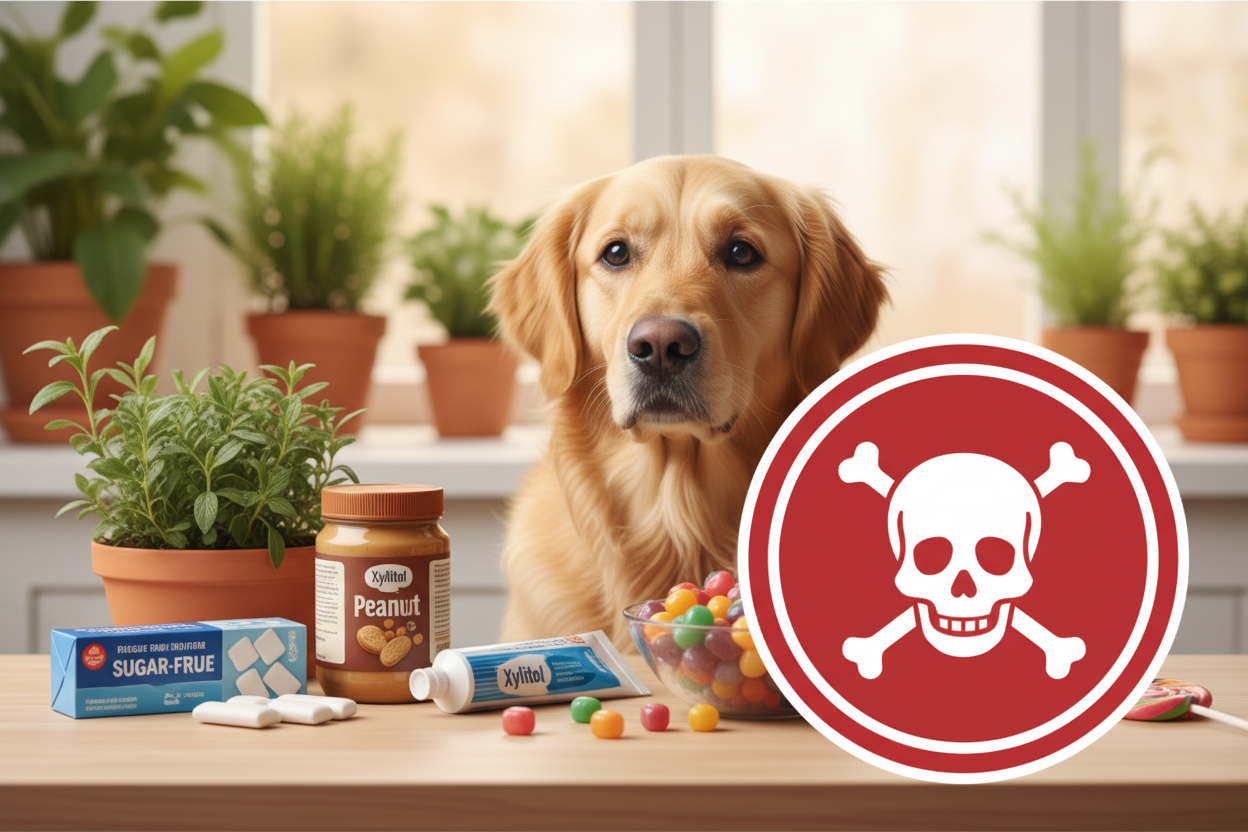
Most UK dog owners know that chocolate is dangerous. Far fewer realise that a single piece of chewing gum — the kind that lives in handbags, coat pockets, car gloveboxes, and desk drawers can kill a dog within hours.
The culprit is xylitol: a sugar substitute used in hundreds of everyday products, increasingly common in UK supermarkets, and extraordinarily toxic to dogs. It's tasteless, odourless, and completely harmless to humans. To a dog, even a small amount can trigger life-threatening hypoglycaemia (dangerously low blood sugar) and, at higher doses, acute liver failure.
This guide covers exactly which UK products contain xylitol, includes a clinically referenced danger calculator based on your dog's weight, and explains what to do immediately if you suspect your dog has eaten something containing it.
What is xylitol and why is it so dangerous for dogs?
Xylitol is a naturally occurring sugar alcohol found in small amounts in some fruits and vegetables. Commercially, it is extracted from plant materials such as birchwood or corncobs and used widely as a sugar substitute because it is as sweet as regular sugar but has roughly half the calories. You will find it labelled as xylitol, but it also goes by other names birch sugar, wood sugar, birch bark extract, birch sap, or the European food code E967.
In humans, xylitol is perfectly safe and does not trigger a significant insulin response. In dogs, the mechanism is completely different. Xylitol is rapidly absorbed into the bloodstream and stimulates a powerful, dose-dependent release of insulin from the pancreas [1, 2]. That insulin surge causes blood glucose to plummet within 15–60 minutes, a condition called hypoglycaemia. Untreated hypoglycaemia can cause seizures, irreversible brain damage, and death.
At higher doses, xylitol can also cause acute liver failure (hepatic necrosis), though the precise mechanism is not yet fully understood [3]. It is important to note that liver failure from xylitol is relatively rare, affecting approximately 1 in 1,000 exposed dogs — but when it does occur it carries a mortality rate of at least 70% [4]. Critically, hypoglycaemia does not always precede liver involvement, so a dog that appears initially stable may still develop serious liver injury 24–48 hours later.
Signs of poisoning can appear within 30 minutes of ingestion or may be delayed for several hours. You should never wait for symptoms to appear before seeking veterinary help.
Xylitol danger calculator based on your dog's weight
The calculator below uses clinically validated dose thresholds from veterinary toxicology literature [1, 2, 5]. Enter your dog's weight, select the product type, and enter the quantity eaten to assess the level of risk. Because xylitol content varies significantly between brands and many manufacturers treat exact xylitol content as proprietary [6] — the calculator uses published ranges and flags uncertainty clearly.
This calculator is a triage tool only. If in any doubt, contact your vet or the Animal PoisonLine immediately do not wait for symptoms.
If the exact amount is unknown, enter the maximum possible — always err on the side of caution.
Thresholds: hypoglycaemia risk >100 mg/kg · liver failure risk >500 mg/kg
Sources: [1] Merck Veterinary Manual (2025) · [2] Piscitelli et al. J Vet Emerg Crit Care 2010 · [3] Dunayer EK. DVM360 2006 · [4] Vetster: Xylitol Toxicosis in Dogs (2024) · [5] American College of Veterinary Pharmacists · [6] Today's Veterinary Nurse: Xylitol — A Sweetener That Is Not So Sweet (2022)
Xylitol content per product: ranges based on published veterinary toxicology literature [5, 6]. Exact content varies by brand and batch — treat all figures as estimates.
UK products that commonly contain xylitol
The following categories are where xylitol most commonly appears in UK households. Always check the label even brands you have used before can change their formulations without prominent notice.
Chewing gum and mints
This is the highest-risk category and the most common cause of xylitol poisoning in UK dogs [5]. Sugar-free chewing gum contains between 300 and 2,000 mg of xylitol per piece depending on the brand [6]. UK products to be especially aware of include:
- Peppersmith — a popular UK dental gum that prominently markets its 100% xylitol formula. Contains very high concentrations per piece.
- Wrigley's Extra — contains xylitol as part of its sweetener blend. Widely available in UK supermarkets, petrol stations, and checkout areas.
- Airwaves and Orbit — both Wrigley's products widely sold in the UK, both contain xylitol.
- Any sugar-free or dental health gum — if it is sugar-free and claims to benefit teeth, assume xylitol is present unless the label states otherwise.
- Sugar-free breath mints — many products including sugar-free Tic Tac varieties use xylitol.
Chewing gum is particularly dangerous because it is small, sweet-smelling, and commonly left within reach in handbags, coat pockets, car seats, and desks. A dog can consume an entire pack in seconds.
Toothpaste and oral care products
- Human toothpaste should never be used on dogs not only because of xylitol, but also because of fluoride toxicity. Always use a dog-specific toothpaste.
- Many UK natural and health food shop toothpastes use xylitol as their primary sweetener.
- Mouthwash left on bathroom surfaces can be lapped up by curious dogs. Many UK mouthwash products contain xylitol.
- Rescue Pastilles (Bach Flower) widely sold in UK pharmacies and health food shops, these contain xylitol.
- Nicotine gum contains xylitol and is a particular risk as it is commonly left in accessible places.
Peanut butter and nut butters
Peanut butter is widely used by UK dog owners to give tablets, fill Kong toys, and reward dogs in training. Most major supermarket brands do not contain xylitol, but some specialist low-sugar and high-protein nut butter products do and formulations can change without obvious labelling updates. Always check the ingredients list for xylitol, E967, or any of its alternative names before giving any nut butter to your dog, even if it is the same brand you have used before.
Vitamins, supplements and medicines
- Chewable and gummy vitamins particularly children's multivitamins
- Sugar-free cough syrups and throat lozenges
- Some oral liquid medications certain oral suspension medicines, including some formulations of gabapentin, fexofenadine, and loratadine, use xylitol as a sweetener [5]. Always check with your pharmacist if you have dogs in the household.
- Melatonin supplements some chewable versions contain xylitol
Low-sugar and diabetic baked goods
Baked goods made for people with diabetes or following keto and low-sugar diets commonly substitute xylitol for sugar. Xylitol is sold in bulk in UK health food shops including Holland & Barrett for home baking. Never share any homemade baked goods with your dog without knowing the full ingredients list even if they appear harmless.
Other food and household products
- Sugar-free jams, spreads, and condiments
- Low-fat yoghurts and diet desserts
- Protein powders and meal replacement drinks
- Sugar-free sweets and confectionery for diabetics (widely available in UK pharmacies)
- Some lip balms, nasal sprays, and skincare products lower-risk but worth knowing
Other names for xylitol on UK ingredient labels
Xylitol does not always appear under that name. It may also be listed as: birch sugar, wood sugar, birch bark extract, birch sap, sucre de bouleau, the European food code E967, Meso-Xylitol, Xlitol, Xylite, or Xylo-pentane-1,2,3,4,5 [5]. If you see any of these on a product your dog has eaten, treat it as xylitol poisoning and act immediately.
Other sugar alcohols such as sorbitol, maltitol, and erythritol are not as acutely toxic as xylitol. Xylitol is by far the most dangerous sugar alcohol for dogs and should be treated with extreme urgency.
Symptoms of xylitol poisoning in dogs
Symptoms can appear within 10–60 minutes of ingestion or may be delayed up to 12 hours. Signs to watch for include [1, 2]:
- Vomiting is often the first sign
- Weakness or lethargy
- Loss of coordination or stumbling
- Dilated pupils
- Tremors or seizures
- Collapse or loss of consciousness
- Yellowing of the skin or eyes (jaundice — indicates liver involvement, typically appearing 24–48 hours after ingestion)
Do not wait for symptoms to appear. If you know or suspect your dog has eaten a xylitol-containing product, contact your vet or the Animal PoisonLine immediately. The prognosis is significantly better when treatment begins before clinical signs develop [4].
What to do if your dog eats xylitol, UK emergency contacts
Act immediately. Do not induce vomiting unless specifically instructed to by a vet — because dogs ingesting xylitol may already be hypoglycaemic, inducing vomiting can worsen clinical signs [1].
Your vet: Call straight away. Take the product packaging so they can see exactly what and how much was consumed.
Animal PoisonLine (UK): Run by the Veterinary Poisons Information Service (VPIS), this is the only 24-hour specialised emergency telephone service in the UK dedicated to pet owners whose pets may have been exposed to something harmful. Call 01202 509 000. Calls cost £35 Monday–Friday 8am–8pm and £45 at all other times including bank holidays.
Out of hours: Contact your nearest emergency vet immediately, do not wait until morning.
For more on understanding vet costs and what to expect in an emergency, see our guide: Understanding Vet Costs: What to Expect and Why They Vary. If the cost of emergency treatment is a concern, our post on the top 10 pet insurance companies for dogs and cats is worth reading — many policies cover emergency poisoning treatment.
How to protect your dog from xylitol at home
- Never leave handbags, rucksacks, or coat pockets accessible to your dog — these are the most common source of chewing gum incidents in UK homes.
- Store all oral care products out of reach — toothpaste, mouthwash, dental floss picks.
- Check every peanut butter label before use — even if it is the same brand you have used before.
- Tell visitors and family members — grandparents and children are particularly likely to share food without knowing the risk.
- Be vigilant at Christmas and Easter — sugar-free sweets, diabetic chocolates, and health food gifts at these times frequently contain xylitol.
- Check medications with your pharmacist — if you are prescribed any oral liquid or chewable medicine, ask whether it contains xylitol and store it securely.
- Never use human toothpaste on your dog under any circumstances.
Other common toxins to know about
Xylitol is one of the most dangerous — but not the only — everyday substance that can harm your dog. Our chocolate toxicity calculator helps you assess the risk if your dog eats chocolate, which remains the most commonly reported cause of canine poisoning in the UK. Our guide on human paracetamol and dogs covers another extremely common household danger that many UK owners seriously underestimate.
If your dog has been suffering from unexplained symptoms and you are trying to identify a cause, our post on why dogs itch and seem unwell and our guide to the financial impact of dog skin allergies may also be useful context.
Keeping your dog safe starts with knowing what is in your home. Please share this post with fellow UK dog owners — the chewing gum risk in particular catches many people completely off guard.
Clinical references
- Merck Veterinary Manual. Xylitol Toxicosis in Dogs. Updated 2025. Available at: merckvetmanual.com
- Piscitelli CM, Dunayer EK, Aumann M. Xylitol toxicity in dogs. Compendium on Continuing Education for the Practising Veterinarian 2010; also indexed on PubMed: PMID 20473849
- Dunayer EK. New findings on the effects of xylitol ingestion in dogs. Veterinary Medicine 2006; 101:791–798. Available via: DVM360
- Dunayer EK, Gwaltney-Brant SM. Acute hepatic failure and coagulopathy associated with xylitol ingestion in eight dogs. Journal of the American Veterinary Medical Association 2006; 229(7):1113–1117. doi: 10.2460/javma.229.7.1113
- American College of Veterinary Pharmacists. Xylitol — pet poison control. Available at: vetmeds.org
- Brutlag A, Hovda L. Xylitol: A Sweetener That Is Not So Sweet. Today's Veterinary Nurse 2022. Available at: todaysveterinarynurse.com
- Blue Cross UK. Xylitol Poisoning in Dogs. Available at: bluecross.org.uk
- Animal PoisonLine (Veterinary Poisons Information Service). 24-hour UK pet poison helpline. Tel: 01202 509 000. Available at: animalpoisonline.co.uk
Disclaimer: This article and calculator are for informational and triage purposes only and do not constitute veterinary advice. The dose thresholds used are based on published veterinary toxicology literature but individual responses vary. Xylitol content in commercial products varies significantly and manufacturers may change formulations without notice. If you suspect your dog has ingested xylitol, contact your vet or the Animal PoisonLine (01202 509 000) immediately. Do not wait for symptoms to appear.

Share:
Paraben The Hidden Ingredient in Most Pet Shampoos That Could Be Harming Your Dog
Dog Contact Dermatitis vs. Seborrheic Dermatitis: Identifying and Treating Skin Issues in Dogs