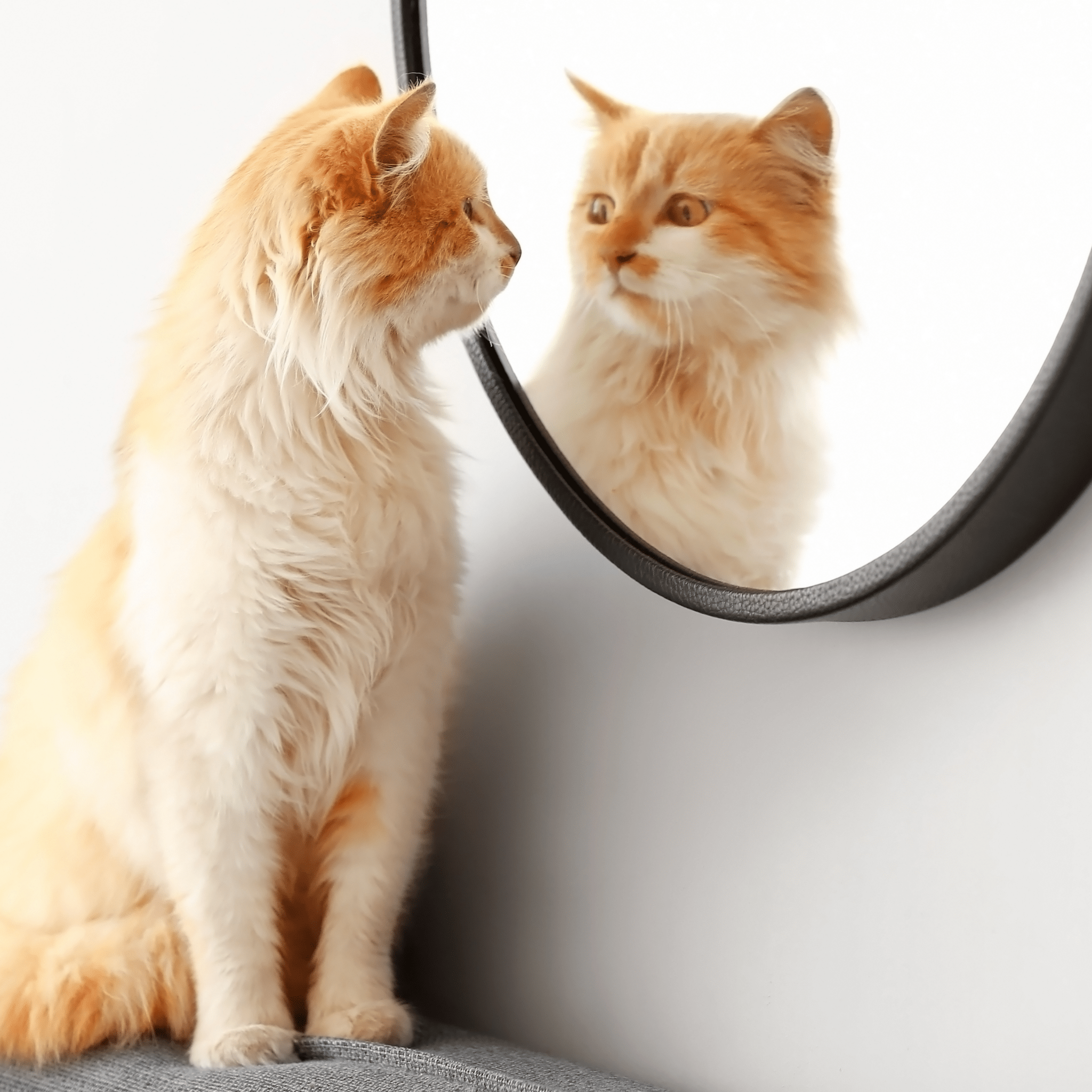
No, cats don't recognize themselves in mirrors. They likely see their reflection as another cat, triggering defensive or curious behaviors. Cats rely on their senses, especially smell, for identification, not visual self-awareness.


If you've ever caught your cat staring at her reflection in the mirror, you might have wondered: does she know it’s herself? Do cats understand mirrors? While many pet owners have seen their felines engage in amusing or puzzling mirror behaviors, the answer to whether cats recognize themselves in a mirror is a bit more complicated than you might think.

The Science of Self-Recognition in Cats

For decades, scientists have explored the concept of self-recognition in animals, including cats. The general consensus among researchers is that cats, like most animals, do not recognize their own reflection. This lack of self-awareness isn't unique to felines; it extends to many species, even some humans at early developmental stages.

As animal psychologist Diana Reiss explains, recognizing oneself in a mirror requires sophisticated cognitive integration of personal movement and visual input. This ability is more complex than many animals possess. Just as human babies take over a year to understand their own reflection, cats too struggle with mirror self-recognition.

Cat Behavior in Front of Mirrors: What’s Going On?

So, when your cat stares at the mirror, what is she actually seeing? Rather than recognizing her reflection as herself, she is more likely viewing it as another cat. This can lead to various behaviors, depending on the cat’s temperament and the situation.

  1. Curiosity: Some cats will simply investigate their reflection, pawing at the mirror or pacing back and forth. They might think it's another cat and wonder what it’s doing.

  2. Defensiveness: Other cats may perceive the reflection as a rival and respond defensively. You might see your cat puff up her tail, arch her back, or hiss at the "other" cat in the mirror. These behaviors are likely reactions to what she perceives as a threat.

  3. Indifference: Some cats, after initial curiosity, may just ignore the mirror entirely, showing that they aren’t too bothered by their reflection.

The Mirror Test: What Science Says About Cat Self-Awareness

One well-known test to determine self-recognition in animals is the mirror self-recognition (MSR) test. This involves placing an animal in front of a mirror to see if it recognizes its reflection as itself. If the animal touches a mark on its body while looking in the mirror, it is considered evidence of self-recognition.

Despite this, most animals—including cats—fail the MSR test. While animals like dolphins, great apes, and elephants have passed, cats don’t seem to have the cognitive ability to associate their reflection with their own identity.

Cats and Their Senses: Why Mirrors Don’t Matter Much

Unlike humans and some other animals, cats primarily use their sense of smell to identify themselves and their environment. They rely on scent more than sight to distinguish between familiar and unfamiliar beings. This means that when your cat interacts with her reflection, she’s not recognizing her own image based on visual cues but is instead trying to make sense of a new, unfamiliar presence. Since she doesn’t identify herself by her appearance, the mirror doesn’t hold much significance.

What to Do If Your Cat Is Stressed by Her Reflection

If you notice that your cat seems stressed or agitated by her reflection, it’s best to remove the mirror. Some cats might get more anxious or territorial, so diverting their attention with toys or other forms of stimulation can help calm them down. If your cat is simply curious, allow her to explore the mirror at her own pace.

Conclusion: Do Cats Understand Mirrors?

In conclusion, cats do not recognize themselves in mirrors. While they may show curiosity or defensive behavior, their interactions with their reflection are more about their instincts and perceptions of a potential intruder. Understanding that cats rely heavily on their other senses, particularly smell, for recognition can help pet owners interpret their feline's behavior in front of mirrors.


FAQs:

  1. Why does my cat react aggressively to her reflection? Your cat likely perceives the reflection as another cat and may become defensive or territorial.

  2. Can cats ever recognize themselves in the mirror? No, cats don’t have the cognitive ability to recognize themselves in a mirror, unlike some other animals.

  3. What should I do if my cat seems stressed by the mirror? Remove the mirror or provide distractions like toys to help reduce any stress or anxiety.

  4. Do cats use their vision to identify people? No, cats rely more on their sense of smell and hearing to recognise their owners and other animals.
Related Studies

View all

Why is my Dog Itching? - FurBabies™ Botanicals | Pet Skin Barrier Repair

Why Is My Dog Itching? Causes, Treatments and When to See a Vet

Why Is My Dog Itching? Causes, Treatments and When to See a Vet Dogs itch for many reasons including parasites, environmental allergies, food sensitivities, skin barrier damage and secondary infections. Identifying the underlying cause is the only way to stop...

Read more

Piriton vs Apoquel vs Cytopoint for Dogs: Which Is Right for Yours? UK Guide

Piriton vs Apoquel vs Cytopoint for Dogs: Which Is Right for Yours? UK Guide

  Important: Piriton, Apoquel and Cytopoint are not interchangeable Piriton is most useful for short-term acute allergic reactions such as insect stings, hives, facial swelling, and mild vaccine reactions. Apoquel and Cytopoint are primarily used to control chronic itching caused...

Read more

Is Xylitol Toxic to Dogs? What It Is, Where It's Found, and How to Check the Risk

Is Xylitol Toxic to Dogs? What It Is, Where It's Found, and How to Check the Risk

  Most UK dog owners know that chocolate is dangerous. Far fewer realise that a single piece of chewing gum — the kind that lives in handbags, coat pockets, car gloveboxes, and desk drawers can kill a dog within hours....

Read more

Paraben The Hidden Ingredient in Most Pet Shampoos That Could Be Harming Your Dog

Paraben The Hidden Ingredient in Most Pet Shampoos That Could Be Harming Your Dog

  Turn over almost any pet shampoo bottle and scan the ingredients list. Somewhere near the bottom you're likely to find one or more of these: methylparaben, ethylparaben, propylparaben, butylparaben. These are parabens, a family of synthetic preservatives used widely across...

Read more

SLS free dog shampoo

Why avoid Shampoos with SLS (Sodium Lauryl Sulphate) & SLES (Sodium Laureth Sulphate)

  Walk down the pet care aisle in any UK supermarket and you'll find shelves of brightly packaged shampoos, many of them foaming generously in their promotional photos. That satisfying lather is largely down to one ingredient: SLS (Sodium Lauryl...

Read more

puppy shampoos not all are made equal

Baby Shampoo for Dogs

  It's one of the most common questions UK dog owners ask: "Can I just use baby shampoo on my dog? It's gentle, isn't it?" It's an understandable instinct baby shampoos are marketed as mild, tear-free, and kind to sensitive...

Read more

selecting the best dog shampoo

Does the choice of shampoo matter?

A good quality pet shampoo should rinse off quickly and completely leaving your pet's coat clean, soft, and free from residue. However with hundreds of products on the market, how do you know which one is actually right for your...

Read more

The Environmental Audit: Is Your Home Making Your Dog Itchy? - FurBabies™ Botanicals

The Environmental Audit: Is Your Home Making Your Dog Itchy?

In our previous deep dives, we explored the "Outside-In" theory and how a "Leaky Skin Barrier" allows irritants to penetrate the skin. But for the owner of a dog with Contact Dermatitis, the biggest question remains: What exactly is getting...

Read more

Dog Contact Dermatitis vs. Seborrheic Dermatitis: Identifying and Treating Skin Issues in Dogs - FurBabies™ Botanicals

Dog Contact Dermatitis vs. Seborrheic Dermatitis: Identifying and Treating Skin Issues in Dogs

Quick Summary (TL;DR) Distinguishing between Contact Dermatitis and Seborrheic Dermatitis is vital for correct treatment. Contact dermatitis is a localised reaction to environmental irritants (like grass or chemicals), while Seborrheic dermatitis involves oily or dry flaking often linked to yeast...

Read more

The Complete Guide to Dog Coats: What Every Pet Parent Needs to Know in 2025 - FurBabies™ Botanicals

The Complete Guide to Dog Coats: What Every Pet Parent Needs to Know in 2025

Quick Answer: Dog coats are essential protective gear for short-haired breeds (Greyhounds, Whippets, Dobermans), small dogs, seniors, and long-haired breeds prone to matting (Poodles, Goldendoodles). The best coats feature high waterproof ratings (10,000-20,000mm), silk or satin linings to prevent matting,...

Read more

Chronic Pain, Muscle Loss, and Early Mortality in Senior Dogs: The Hidden Threat of Sarcopenia - FurBabies™ Botanicals

Chronic Pain, Muscle Loss, and Early Mortality in Senior Dogs: The Hidden Threat of Sarcopenia

  Even with arthritis meds for dogs, joint chews, or other good joint supplements for dogs, chronic pain can silently destroy muscles in senior dogs. This process, called sarcopenia (age- and pain-related loss of muscle mass and strength), happens because pain...

Read more

How can I check if my dog’s flea or tick treatment is genuine in the UK? (VMD verification + real owner story) - FurBabies™ Botanicals

How can I check if my dog’s flea or tick treatment is genuine in the UK? (VMD verification + real owner story)

Check the pack’s VM number against the VMD Product Information Database on GOV.UK. If the VM, manufacturer and leaflet match the database entry, the product is authorised; if not, don’t use it. Immediate story hook  “I hadn’t left my flat...

Read more